
According to a landmark attachment study by Dr. Kristyn Vitale, Oregon State University, published in Current Biology, 2019, 65.8% of domestic cats form secure attachment bonds with their owners – the same attachment style documented in human infants and dogs, and long assumed cats were incapable of forming.
That finding reframes the question most prospective cat owners ask. Are cats loyal to humans? Research confirms that most cats are. The more useful question is which breeds express that loyalty most intensely, and which form bonds so focused that they become genuinely devoted to a single person.
A loyal cat is a cat that actively seeks proximity, monitors its owner’s emotional state, and shows measurable distress when separated from its primary attachment figure, a behavior pattern that certain breeds display consistently above the general domestic cat baseline.
Are Cats Loyal to Humans? What the Research Actually Shows
Cat loyalty is real, specific, and sometimes underestimated precisely because it looks different from dog loyalty. According to cat behavior researcher Dr. Kristyn Vitale, PhD, speaking to the APA’s Speaking of Psychology podcast, cats are “just as emotionally attached to us as we are to them”, but express attachment through proximity-seeking, gaze, and subtle behavioral signals rather than the demonstrative engagement dogs use.
How Cats Show Loyalty
Research from the University of Lincoln, published in Animals, 2021, analyzed 3,994 cat-owner relationship responses and identified “cat’s need for owner proximity” as one of the four primary dimensions defining the cat-human bond. Cats that score highly on this dimension follow their owners between rooms, position themselves consistently near their primary person, and show behavioral changes – reduced appetite, increased vocalization, altered sleeping patterns – when that person is absent.
Why Some Breeds Bond More Intensely Than Others
Breed temperament directly predicts where a cat falls on the attachment spectrum. Breeds developed for human companionship rather than working or outdoor roles consistently show higher proximity-seeking, stronger social attunement, and more person-specific bonding than breeds shaped by independent survival. This is the biological foundation of the most loyal cat breed designations.
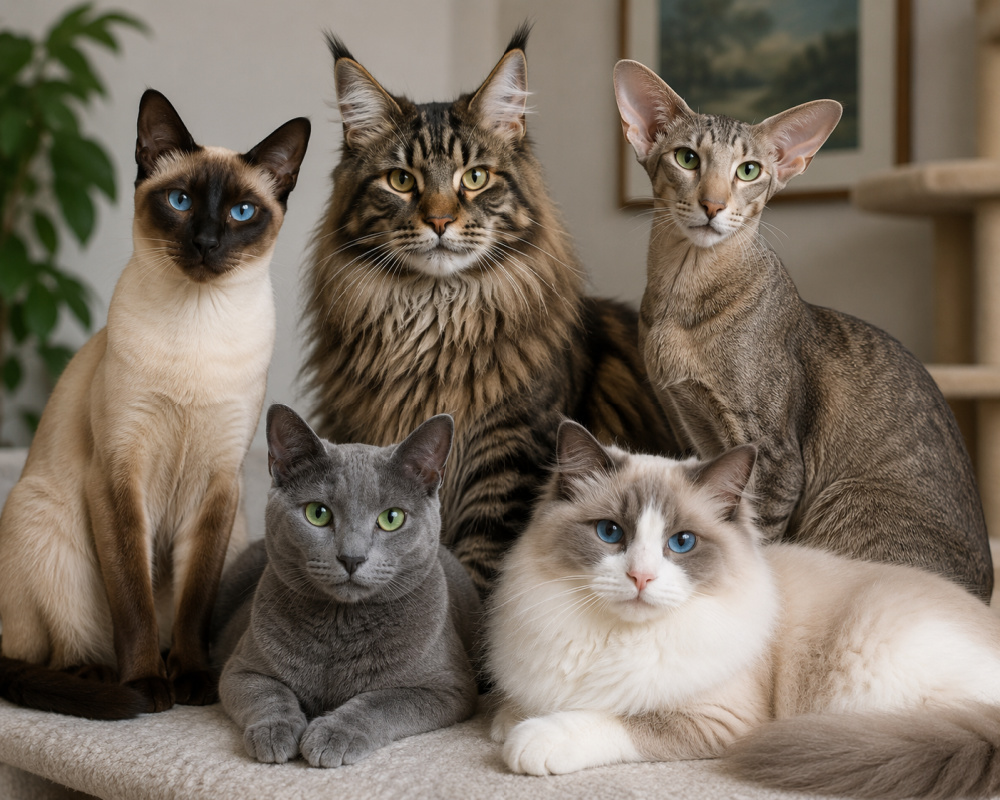
5 Most Loyal Cat Breeds That Bond Deeply With One Person
1. Oriental Cat
The Oriental cat is the most intensely person-bonded domestic cat breed available. Closely related to the Siamese in temperament and origin, Orientals form singular, deep attachments that owners consistently describe as more analogous to a devoted dog than a typical cat. They follow their chosen person from room to room, vocalize persistently when that person is absent, and show clear preference through positioning, contact-seeking, and gaze for one individual above all others in a household.
Orientals are not a breed for owners who want a companion that distributes affection evenly. Their loyalty is concentrated, specific, and deeply felt, and for the owner who becomes their person, the relationship is unlike anything most breeds offer.
2. Siamese
The Siamese shares the Oriental’s social intensity and one-person orientation, expressed through its famously vocal, communicative personality. Siamese cats narrate their day to their chosen person, monitor their owner’s schedule with uncanny accuracy, and become visibly distressed when routines are disrupted. Their loyalty is active and expressive – never passive companionship.
3. Russian Blue
The Russian Blue bonds deeply but quietly, forming an intense attachment to one person that it expresses through consistent proximity, subtle gaze behavior, and a sensitivity to its owner’s emotional state that longtime owners describe as almost therapeutic. Russian Blues are reserved with strangers, which makes their loyalty to their chosen person more visible by contrast. They become a different cat entirely in the presence of their person.
4. Maine Coon
The Maine Coon’s loyalty is broad rather than exclusive. It bonds with the whole family rather than a single person, but the depth of that bond is remarkable. Maine Coons follow their people through the home, participate in daily activities, and show the dog-like companionship behaviors that make them one of the most consistently described “loyal breeds” in owner surveys. For households rather than individuals, the Maine Coon offers the deepest available multi-person bond.
5. Ragdoll
Ragdolls bond with quiet devotion. Their tendency to follow their owners from room to room, settle nearby during sedentary activity, and seek gentle physical contact throughout the day reflects a deep, consistent attachment that expresses itself in sustained proximity rather than vocal demand. Ragdoll owners frequently describe the feeling of being genuinely chosen by their cat – a relationship quality that the breed delivers with unusual reliability.
How Do These Breeds Compare?
| Breed | Bond Type | Expression Style | Best For |
| Oriental | Intense, one-person | Vocal, active, proximity-seeking | Single-person households |
| Siamese | Intense, one-person | Vocal, communicative, schedule-attuned | Active, interactive owners |
| Russian Blue | Deep, quiet | Subtle, proximity, emotional attunement | Calm, consistent households |
| Maine Coon | Deep, family-wide | Participatory, dog-like | Families and multi-person homes |
| Ragdoll | Deep, gentle | Quiet proximity, physical closeness | Low-intensity, devoted companionship |
What the Most Loyal Cat Breeds Require in Return
Loyalty of this depth is not self-sustaining. The breeds above, particularly the Oriental, Siamese, and Russian Blue, form bonds that generate genuine distress when primary owners are frequently absent or inconsistent in their interaction. Under-stimulated loyal cats develop anxiety-driven behaviors: excessive vocalization, over-grooming, and destructive redirection of social energy.
The most loyal cat breed is a cat that gives more than the average breed and requires proportionally more in return: consistent presence, daily interaction, and an owner who understands that the bond is not metaphorical.
Loyalty Is a Two-Way Relationship
Research confirms that cats form secure attachment bonds, monitor human emotional states, and direct loyalty toward specific individuals with measurable consistency. The breeds above take that general feline capacity and express it at its most concentrated, producing relationships that routinely surprise owners who expected the independence the cat stereotype promised.
For owners ready to be chosen completely by an Oriental, followed devotedly by a Ragdoll, or understood quietly by a Russian Blue, these breeds deliver a depth of companionship that makes the investment in their social needs entirely worthwhile.
Frequently Asked Questions
Are cats loyal to humans the way dogs are?
Cats form secure attachment bonds with owners at a comparable rate to dogs – Dr. Kristyn Vitale’s Oregon State University research found 65.8% of cats show secure attachment. The difference is expression: cats signal loyalty through proximity, gaze, and emotional attunement rather than the demonstrative engagement dogs use. The bond is equally real; the behavioral language is subtler.
Which is the most loyal cat breed for a single person living alone?
The Oriental cat is the strongest single-person loyalty breed available. Its attachment is concentrated on one individual, expressed actively through following, vocalization, and persistent proximity-seeking. Siamese cats are a close equivalent of a similarly intense one-person orientation. Both require owners who are home regularly and can reciprocate the social engagement these breeds direct toward their person.
Can a loyal cat breed become attached to multiple people?
It depends on the breed. Orientals and Siamese tend toward one-person primary attachment while tolerating others. Maine Coons and Ragdolls bond broadly across the whole household, showing consistent affection toward multiple family members without the same singular intensity. For families, Maine Coon or Ragdoll loyalty distributes more evenly and sustainably.
How do I know if my cat has bonded deeply with me?
Consistent proximity-seeking – following you between rooms, resting near rather than on you, monitoring your location – is the most reliable indicator of deep attachment. Behavioral changes when you are absent (reduced appetite, altered sleep, increased vocalization) are the most measurable. Cats that show these patterns are displaying secure attachment as defined in peer-reviewed research, not simply conditioned feeding behavior.
Do loyal cat breeds suffer more when left alone?
Yes, proportionally. Oriental cats, Siamese, and Russian Blues have higher social needs and lower tolerance for owner absence than more independent breeds. Extended daily solitude generates anxiety in these breeds that manifests as vocalization, over-grooming, or destructive behavior. A companion cat, consistent daily interaction, and enrichment during absence periods are practical requirements for these breeds, not optional extras.