

Veterinarian reviewed by Dr. Paula Simons
Updated 7/23/26
If you’ve ever seen your Chihuahua suddenly hop along on three legs for a few steps before acting like nothing happened, you’re not alone. That funny little “skip” is one of the most common signs of a luxating patella, a condition that affects many small dogs—especially Chihuahuas.
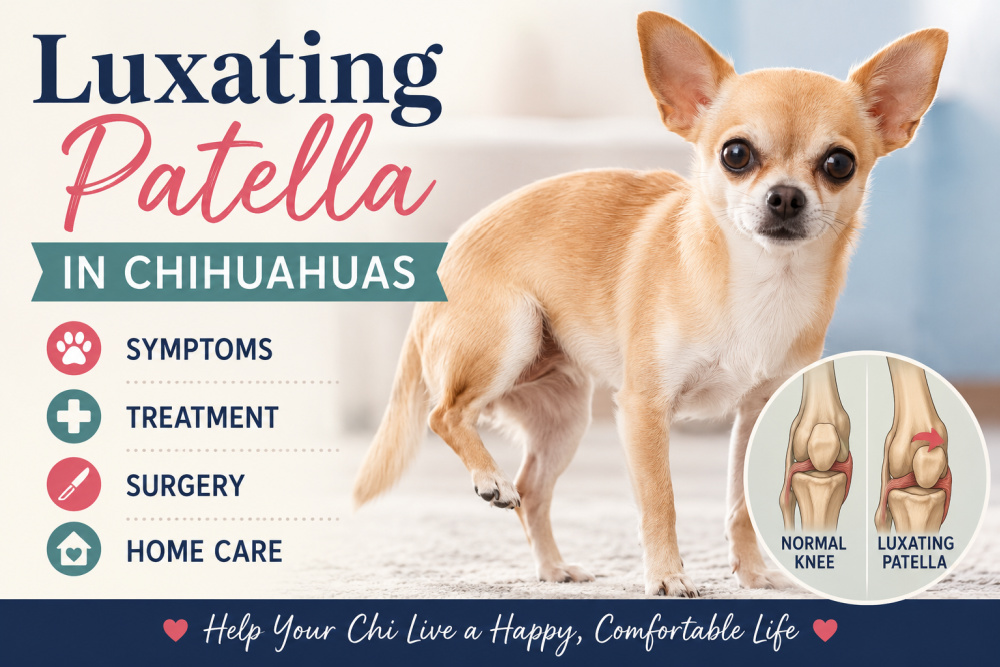
The first time you see it, it can be alarming. You may think your dog has injured a leg, only to watch them run across the room a few seconds later as if nothing ever happened.
In many cases, that’s exactly how a luxating patella behaves.
The good news is that while this condition can sound scary, many Chihuahuas live long, active, happy lives with proper care. Some dogs only experience occasional mild symptoms, while others benefit from surgery to keep them comfortable.
Let’s take a closer look at what a luxating patella is, what causes it, and what you can do if your Chihuahua has been diagnosed with one.
What Is a Luxating Patella?
A luxating patella is the medical term for a kneecap that slips out of its normal position.
The patella (kneecap) normally sits inside a small groove at the end of the thigh bone (femur). As your Chihuahua walks, runs, or jumps, the kneecap glides smoothly up and down within that groove.
With a luxating patella, the kneecap slips out of the groove instead of staying in place. It may slide to the inside or outside of the knee before popping back where it belongs.
Some dogs only experience this occasionally, while others have kneecaps that remain out of place much of the time.
Why Are Chihuahuas So Prone to Luxating Patellas?
Unfortunately, Chihuahuas are one of the breeds most commonly affected by this condition.
In most cases, it’s inherited rather than caused by an injury. Many affected dogs are simply born with knee joints that don’t fit together quite as they should.
Factors that can contribute include:
- A groove that’s too shallow to hold the kneecap securely
- Loose ligaments around the knee
- Slightly abnormal leg alignment
- Tiny body size combined with delicate joints
- Genetics
Extra body weight can also make symptoms worse because it places additional stress on already unstable knees.
That doesn’t mean every Chihuahua will develop a luxating patella, but it does explain why veterinarians diagnose the condition so often in toy breeds.
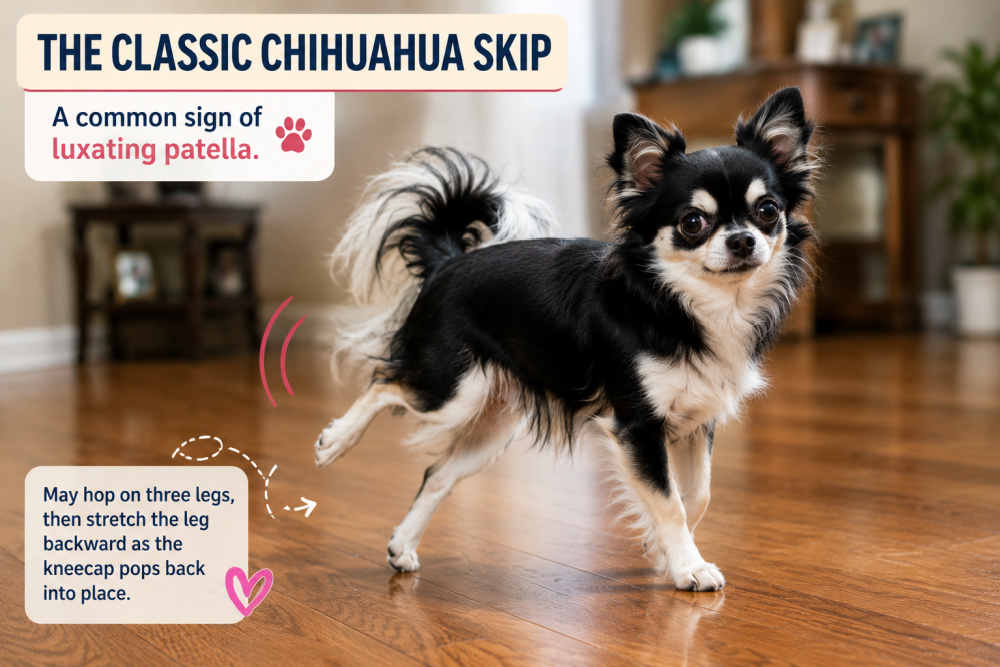
The Classic “Chihuahua Skip”
One of the most recognizable signs is what many owners call the Chihuahua skip.
Your dog may:
- Suddenly lift one back leg
- Hop on three legs for several steps
- Stop briefly
- Stretch the leg backward
- Then continue walking normally
What’s happening?
When the kneecap slips out of place, your Chihuahua instinctively holds the leg up because moving it feels uncomfortable. As the leg extends, the kneecap often slides back into its normal position.
Once that happens, your dog acts as though nothing ever happened.
This can happen several times a day—or only once every few weeks.
Many owners assume their Chihuahua has pulled a muscle because the limp disappears so quickly. That’s one reason it’s important to mention these episodes to your veterinarian, even if they don’t last long.
What Causes a Luxating Patella?
Although trauma can occasionally cause a luxating patella, inherited anatomy is responsible for most cases in Chihuahuas.
Common causes include:
Genetics
This is by far the biggest factor. Responsible breeders work to avoid breeding dogs with orthopedic problems, but luxating patellas can still occur.
Abnormal Bone Development
Some dogs are born with slight differences in how their leg bones develop. These changes can prevent the kneecap from tracking properly.
A Shallow Femoral Groove
The kneecap sits inside a groove on the thigh bone. If that groove isn’t deep enough, it’s much easier for the kneecap to slide out.
Trauma
Although less common, falls, accidents, or injuries can damage the knee and lead to a luxating patella.
Excess Weight
Being overweight doesn’t usually cause the condition, but it can increase stress on the joints and make symptoms more severe.
Signs and Symptoms of a Luxating Patella
Every Chihuahua is different.
Some dogs show almost no symptoms, while others become increasingly uncomfortable as the condition progresses.
Watch for:
- Skipping while walking
- Sudden hopping on three legs
- Holding one rear leg up
- Stretching a hind leg behind them
- Intermittent limping
- Difficulty jumping onto furniture
- Trouble climbing stairs
- Stiffness after resting
- Reluctance to exercise
- Bunny hopping while running
- Muscle loss in one hind leg over time
- Arthritis as they get older
As the condition becomes more severe, the kneecap may stay out of place longer and become increasingly painful.
The Four Grades of Luxating Patella
Veterinarians classify luxating patellas into four grades based on how easily the kneecap moves and how often it stays out of place.
Grade 1
The kneecap stays in its normal position most of the time and only slips out when manipulated during a veterinary exam.
Many dogs have few or no symptoms.
Grade 2
The kneecap pops out occasionally during normal activity but usually slides back into place on its own.
This is the stage where many owners notice the classic Chihuahua skip.
Grade 3
The kneecap is out of place much of the time but can still be manually moved back into position.
Dogs often have a noticeable limp and may begin developing arthritis.
Grade 4
The kneecap remains permanently out of place and cannot be returned to its normal position manually.
These dogs often have significant mobility problems and usually require surgery to improve comfort and function.
How Is a Luxating Patella Diagnosed?
Your veterinarian can often diagnose a luxating patella during a physical examination.
They’ll gently manipulate the knee to determine whether the kneecap slips out of its groove and how easily it returns.
Depending on your dog’s symptoms, your veterinarian may also recommend:
- Watching your Chihuahua walk
- Checking for pain or swelling
- X-rays to evaluate the knee joint
- Looking for arthritis
- Checking for other orthopedic injuries, such as a torn cruciate ligament
In more complicated cases, your veterinarian may refer you to a veterinary orthopedic surgeon for additional evaluation.
Treating a Luxating Patella
Treatment depends on several factors, including your Chihuahua’s age, activity level, pain level, and the grade of the luxating patella.
Fortunately, not every dog needs surgery.
Mild Cases
Many Chihuahuas with Grade 1 or mild Grade 2 luxating patellas do well with conservative management.
Treatment may include:
- Maintaining a healthy weight
- Regular, low-impact exercise
- Prescription pain or anti-inflammatory medications when needed
- Physical rehabilitation exercises
- Monitoring for worsening symptoms
Many owners also ask about joint supplements.
While research on supplements varies, some veterinarians recommend products containing glucosamine, chondroitin, omega-3 fatty acids, or green-lipped mussel as part of an overall joint health plan. Talk with your veterinarian about whether they’re appropriate for your dog.
When Is Surgery Needed?
Not every Chihuahua with a luxating patella needs surgery. Many dogs with mild cases live happy, active lives with careful management.
However, surgery may be recommended if your Chihuahua:
- Has frequent or persistent limping
- Appears to be in pain
- Has difficulty walking or running
- Has a Grade 3 or Grade 4 luxating patella
- Has arthritis that is getting worse
- Stops enjoying normal activities
- Has repeated kneecap dislocations that affect their quality of life
Your veterinarian or a veterinary orthopedic surgeon will discuss the best option based on your dog’s age, overall health, activity level, and severity of the condition.
What Happens During Luxating Patella Surgery?
There isn’t just one type of surgery for a luxating patella. The procedure is customized to correct the problems causing the kneecap to slip out of place.
Depending on your Chihuahua’s knee, the surgeon may:
- Deepen the groove where the kneecap sits
- Move the tendon attachment so the kneecap tracks correctly
- Tighten tissues on one side of the knee
- Loosen tissues that are pulling the kneecap out of alignment
- Correct bone alignment in severe cases
The goal is to keep the kneecap in its proper position so your Chihuahua can walk comfortably again.
While surgery sounds intimidating, it has a high success rate when performed by an experienced veterinarian or veterinary orthopedic surgeon.
Recovery After Surgery
Recovery doesn’t happen overnight, but most dogs improve significantly with time and proper care.
For the first several weeks, your Chihuahua will likely need:
- Plenty of rest
- Short leash walks only
- No jumping on furniture
- No running or rough play
- Pain medication as prescribed
- Follow-up veterinary visits
Some veterinarians also recommend physical rehabilitation exercises to help rebuild muscle strength and improve flexibility.
Complete recovery may take anywhere from two to four months, depending on the procedure and your dog’s overall health.
Although it can be challenging to keep an energetic Chihuahua quiet, following your veterinarian’s instructions gives your dog the best chance for a successful outcome.
How to Help a Chihuahua With a Luxating Patella at Home

Whether your dog has surgery or is managing a mild case without it, there are several things you can do at home to help protect their knees.
Keep Your Chihuahua at a Healthy Weight
Even a few extra pounds place additional stress on the knee joints.
Maintaining a healthy body weight is one of the best things you can do to slow the progression of joint disease and improve your dog’s comfort.
Use Pet Ramps or Stairs
Repeatedly jumping off beds and couches creates extra impact on the joints.
Pet stairs or ramps can help reduce that stress while still allowing your Chihuahua to enjoy their favorite spots.
Provide Non-Slip Flooring
Hardwood, tile, and laminate floors can be slippery.
Adding area rugs or non-slip runners helps your Chihuahua maintain better footing and reduces the risk of falls.
Encourage Regular Exercise
It may seem surprising, but gentle exercise actually helps many dogs with joint problems.
Short walks help maintain muscle strength, which provides better support for the knee.
Avoid intense activities that involve lots of twisting, jumping, or sudden stops.
Keep Nails Trimmed
Long nails change the way a dog stands and walks, which can place extra strain on the joints.
Regular nail trims help your Chihuahua maintain better balance and posture.
Follow Your Veterinarian’s Recommendations
Every dog is different.
Some Chihuahuas do well with conservative treatment for years, while others eventually need surgery.
Regular checkups allow your veterinarian to monitor changes and adjust your dog’s treatment plan if needed.
Can Luxating Patellas Be Prevented?
Because most luxating patellas are inherited, there’s no guaranteed way to prevent them.
However, you can reduce your Chihuahua’s risk of developing more severe symptoms by:
- Keeping them at a healthy weight
- Providing regular, low-impact exercise
- Preventing excessive jumping from high furniture
- Using ramps or stairs when possible
- Feeding a balanced diet
- Scheduling regular veterinary checkups
If you’re purchasing a Chihuahua puppy, ask the breeder whether their breeding dogs have been screened for orthopedic problems. Responsible breeders work to reduce the risk of passing inherited conditions to future generations.
When Should You Call the Vet Right Away?
While occasional skipping may not be an emergency, some symptoms should be evaluated as soon as possible.
Contact your veterinarian promptly if your Chihuahua:
- Cannot put any weight on a leg
- Cries out in pain repeatedly
- Has significant swelling around the knee
- Keeps the leg tucked up for an extended period
- Suddenly becomes much less active
- Experiences symptoms after a fall or accident
- Seems to be in severe pain
These signs could indicate a more serious injury or another orthopedic problem that requires immediate treatment.
Frequently Asked Questions
Can a Chihuahua live with a luxating patella?
Yes. Many Chihuahuas with mild luxating patellas live normal, happy lives with weight management, regular veterinary care, and activity modifications. More severe cases may require surgery to keep them comfortable.
Does every Chihuahua with a luxating patella need surgery?
No. Dogs with mild cases often do well without surgery. Your veterinarian will recommend surgery only if the condition is causing significant pain, mobility problems, or repeated dislocations.
Can a luxating patella heal on its own?
Unfortunately, no. Because it’s usually caused by the way the knee is formed, it won’t correct itself. However, many dogs can successfully manage the condition without surgery.
Is walking good for a dog with a luxating patella?
Yes, in most cases. Gentle, regular walks help maintain muscle strength, which supports the knee joint. Avoid strenuous exercise or activities involving repeated jumping unless your veterinarian says they’re appropriate.
Can both knees be affected?
Yes. Many Chihuahuas eventually develop luxating patellas in both back legs, although one knee is often worse than the other.
Is a luxating patella painful?
It can be. Some dogs only experience occasional discomfort when the kneecap slips out of place, while others develop chronic pain from arthritis or repeated dislocations.
How much does luxating patella surgery cost?
Costs vary depending on where you live, the severity of the condition, and whether a board-certified orthopedic surgeon performs the procedure. Your veterinarian can provide an estimate based on your Chihuahua’s specific needs.
Final Thoughts
Hearing that your Chihuahua has a luxating patella can be worrying, especially if you’ve never heard of the condition before. Fortunately, it’s one of the most common orthopedic problems seen in small dogs, and veterinarians have a great deal of experience treating it.
Over the years, members of the I Love My Chi community have shared many stories about dogs living with luxating patellas. Some only skip occasionally and never need surgery, while others have surgery and go on to enjoy active, happy lives. Every Chihuahua’s journey is a little different.
The most important thing is to work closely with your veterinarian, keep your dog at a healthy weight, and pay attention to changes in their mobility. Early treatment and good home care can make a tremendous difference in your Chihuahua’s comfort and quality of life.
With the right care, there’s every reason to believe your little companion can continue enjoying walks, playtime, cuddles, and all the things that make Chihuahuas such wonderful members of the family.
Click to find about other chihuahua health problems.

References:
American College of Veterinary Surgeons (ACVS). Patellar Luxation. Retrieved on February 20, 2016 from: https://www.acvs.org/small-animal/patellar-luxations
Hettlich, B. (2014). Patellar Luxation. World Small Animal Veterinary Association World Congress Proceedings. The Ohio State University, Columbus, OH, USA

Paula Simons
DVM
This article has been reviewed, fact-checked, and approved by Dr. Paula Simons DVM. You can read more about her on our About page.
My boy is terrible for jumping off things and jumping several stairs at a time. Occasionally he holds up his back leg after a big jump. No matter how much I discourage him doing this he continues. Does this sound like he has this condition
Yes he could have it, or he could just be hurting his legs from the jump. I think I would block off the stairs with baby gates and just carry him downstairs to keep him from doing this.
The stairs are in the garden so I have no way of blocking them off ?
That’s too bad Angela.
Both my boys knees wobble when he walks but is fine trotting and galloping jumps of things and plays ruff no sign of pain, what do you think? THANKYOU
They could be in the first stages Jackie but as long as they are in pain, I wouldn’t worry about it. If it gets worse or they seem like they are hurting, definitely get them checked out.
Since our last chat his knee locked he’s A little sore will this now be an on going thing.vet said that op is out of the question because of his size .
Poor baby! There’s nothing else they can do for him?
My chi just had to have surgery on both knees because of this. He was a stage 4 and isn’t even 4 years old yet! He’s very active, so we are hoping this will greatly improve his quality of life. So far, so good!
May I ask the cost of such surgery? Mine is stage 4 of 4 with his and is 12 years old.
Hi Karen,
It really depends on the area you live in and your vet, but it can range from around a thousand dollars to 3 thousand. Check and see if you have a veterinary college within driving distance from you as you can often get it through them much cheaper. Some areas have low cost vet services too that you might want to check for. I know we have one several hours away from me in Richmond VA that does surgeries for much less than regular vets. Also check and see if your local SPCA has a vet clinic attached. They are cheaper than regular vets too.
I have three Chihuahuas and lost one. Three out of my four have/had this. Two out of the three would hold their leg up and looked like they are skipping. My third one (my youngest) seems to be a little worse off. She just had to be on a anti inflammatory for eight days. She’s doing much better but only time will tell if she’ll be in pain again. Surgery is a possibility but quite frankly scares me. We’re praying she’ll be okay and just irritated it.
Oh wow, that’s too bad. Were they all from the same family? This condition is common in chis but not that common. Poor babies.
Hi how did your Chi make out , did the anti inflammatory work? My 1 1/2 year chi just hurt his leg , i maybe his knee also so he’s now day one on the drugs. I hope this works,
my four year old has it in one leg the vet says she’s to small to have surgery and will get arthritis in it if she operates or don’t .
Poor little girl. Hope she feels better.
I just adopted a little girl last month that had a severe case (Grade 4) she was a rescue…someone actually was awful enought to breed her long before I got her…needless to say when she got to TRACS ( the rescue group I adopted her from) she was in pretty bad shape but would still try to run and play…she had a major surgery and I picked he up about a week and a half later…I have her on Dasuquin and have had her rechecked and she is doing AMAZING…she flies through the house like a little tornado and chases and plays with her furbrothers all day long..we have also been doing wtarer therapy (per my vet) where I hold her in a tub of water and have her swim to help strengthen those back legs that she rarely used…she is getting stronger everyday and I am so thankful that she is not in pain anymore
That’s fantastic Dawn! Your fur baby is lucky to have you for her momma! Sounds like you have done a lot to help her get healthy.
There’s an alternative to surgery for luxating patella. I sprinkled half of a chew every day for my Pom, and within 3 days she was running around like a puppy for the rest of her life. It’s a supplement, so it’s not medication and it’s rich in antioxidants so the overall health is better, too! http://amzn.to/2ty6KuS
I have read that Glucosamine works on dogs 10 times better, then on humans. Also, boron is very important for treating and reversing symptoms of arthritis. Give a very tiny pinch from capsule 5 days a week with two days off. Great for humans too! http://www.dogsnaturallymagazine.com/top-5-remedies-dog-joint-pain-injury/ and
I didn’t know Glucosamine worked better in dogs. I know I tried it for me and it didn’t do much for me. One of my dogs is getting worse with arthritis and could use the help.
Hello
Can I just ask, did u have to carry on this forever or just a limited time?
Thanks 🙂
I have found some wonderful remedies from cell salts. Rhus tux is a miracle for knee arthritis. My little chi doesn’t limp any more. She has started running more too. http://www.dogsnaturallymagazine.com/top-5-remedies-dog-joint-pain-injury/
I have a 10 mo. Chi that will occasionally skip one step when trotting. Once or twice almost each day. I’ve been showing her and she moves beautifully and uses her rear better than most. Her patelas palpate normal by my vet and she never shows pain, but I’m worried about her passing OFA when she’s 12 mo. Is Grade 1 a normal rating?
It’s not as good as a 0 but it’s not bad. Just something to keep an eye out for as she gets older.
My boy is 4.5 yrs old. He’s a Chi/Yorkshire mix and has a bad back leg. He’s on glucosamine but not seeming to help. We don’t over feed him, the vet says his weight is fine but could be arthiritis. Now lately he holds up his front leg to his chest and doesn’t want to move. He’s limping more every day it seems. Do you think he needs surgery? He’s not the same guy he used to be and it’s killing me!
Poor little guy! He may very well need surgery. I’d tell your vet that he’s getting worse and see what he/she says.
My girl has had this for 3 years. She is very physical, and keeping her from jumping is hard! This is her third bout with Carprofen 25 mg caps . She gets 1/2 in AM and PM. It seems to make her not hurt, but she still wants her walks. She is 9.
Yeah it’s so hard to keep them still when they are active like that. They just don’t understand.
My fur-baby Precious had patella luxation in both rear legs and i had the surgery done on both her knees. it wasn’t cheap. About 2500 for each leg and she still has pain because she also has arthritis in both legs. She will be 14 this December. the surgery was a success in both legs and was done when she was either 10 or 11 yrs old. she is about 12 pds and seems chunky for her size. if i see that she is in some pain from the arthritis i give her a half a pill of vetprofen and that seems to help. it is not easy but she is my baby and i would do anything for her. I had 4 Chi’s, the momma the poppa and 2 daughters. i lost the momma in 2013 from airway disease and one of the daughters this March from cancer. the 2 i have left are the poppa and the other daughter and they are both senior dogs. i love them with all my <3. i have attached a pic of Precious who i call my black bear sometimes LOL
You sound like a wonderful pet momma Esther!
I haven’t heard of vetprofen before. Is that something you have to get from the vet?
My chi has it too and when we go on walks his back legs bow out. Does not seem to be in pain though. Then they can snap back. But wants to stop walking when knees are bowed out.
My 21 month old chi has a right leg luxating patella, currently at stage 1 – 2. She only runs with that leg lifted when she runs on grass. So far it doesn’t appear to affect her walking. My vet has told us to watch it and consider surgery if it gets to stage 2 – 3, but in the meantime she is taking a daily joint supplement tablet, containing glucosamine and chrondroitin, to strengthen her joints and ligaments and hopefully avoid the problem progressing for as long as possible.
Do you think the supplement is helping her Elaine?
@Cathy, I’m not sure yet, but it doesn’t appear to trouble her too much, and the ‘skipping’ doesn’t seem to be getting any worse. We’re due to take her for her annual checkup next month, but still isolating here in the UK, so may not be able to yet.
I have a 7 year old chi and was just diagnosed with luxating patella in both knees, but is only limping on one side. They sent her home with pain meds and said if she is still limping in 7 days to meet with the surgeon and she will probably need surgery. I’m torn what to do cause some days she’s fine and other days she limps so much!
Yeah that’s a tough one Karla. Let us know how it turns out.
We just adopted a seven year old girl, Lala last week. She seems to have this in both hind legs. We started her on the joint ‘treats’ that we currently give our eight year old pibble. We walk her two plus times daily along with our pibble, Charlie. Both in grass at parks and sidewalks in town. He has even slowed his walk to let her keep up. We are hoping that walks will help strengthen her muscles. It seems to be working in this short time. She does ok on the front stoop steps – there are two, but struggles with the back entry that has a step up. She watched our cat jump up, so now she she does a slight run and jump with a light slide on her landing. We will modify this with a ramp now that we read it could be a painful issue rather than just a coordination issue. Her prior owners never took her for walks. She just lounged in the yard or in the house.
It sounds like you are doing all the right things Patty. What supplement are you giving her?
I have a 14 year old rescue chihuahua with a luxating patella and a torn ligament. She’s been to the surgeon who has recommended surgery for both problems. I just don’t know what to do 🙁 I’m not ready to say goodbye, and I don’t think she is either, but I haven’t been able to find information on doing this surgery on such a senior girl. Do you have any opinion you could share?
Not really Caroline except from what I hear from pet parents who’s dog had the surgery, most were pleased with the outcome.
@Cathy, thank-you for your reply. This is such a hard thing to decide, only because I want to do the best for my little one.
I have a 7 pound chihuahua about 2 years old and he has a grade 3 knee dislocation and he also has a deformed hip. We are getting many opinions and since he is just about two we are considering amputating cause we have talked to a lot of people and going through with the multiple surgery’s can cause a lot of scar tissue and arthritis in his back left leg for the rest of his life and with amputation it’s less healing time and he wouldn’t have to deal with arthritis and painful surgery’s and physical therapy. Our vet is kinda leaning towards amputation and so are we but we’re getting a second opinion from another vet. What do you think?? *I wish I could put in a photo of the x rays
That’s a tough one Ella. I’m not sure what I would do if I were in this situation. I’d definitely get a second opinion from another vet before deciding.
How old should my chihuahua be before getting knee fixed one vet told me 6 months
Is your dog having issues with it now? Most vets wait til the dog gets older or is having problems with it. But I’m not a vet and do not know the specific issues with your pup. If it were me, I think I would get a second opinion before making the decision.
My chihuahua just had patella Luxation surgery two weeks ago he is a year old took him to get his stitches out the checked him on how the surgery went they said it failed, and they are wanting to do more surgery on him, is this a good idea? What will happen if I decide not to have another surgery done ???? Thanks Fred Traceski
Wow Fred, that’s really disheartening! I’m not a vet so I’m not sure what will happen to him if he doesn’t get the second surgery. I think I would get a second opinion from another vet and see if what your options are.
Hello from a former UA resident, long ago patient of OSU’s George Paulson. I have adopted a 7 year old, tiny Chihuahua. This one, as previous ‘mother’ told me has developed a problem the last few years. Sadly she’s had nothing done to help correct it. If possible.
His front legs/paws turn under. He’s hobbling only on his ‘knees’. The position feels stiff/fixed.
I’ve not had him to a vet. I live in an area with several. (But personally had two bad M.D. experiences, so very hesitant to trust any to be able to help.)
Wish I could send photos.
Poor little guy! He definitely needs to see a vet and will probably need surgery.
My pomchi just had a visit to the vet today because I felt a hard lump by her knee cap. She’s had it a few weeks before and it went away but I noticed it again yesterday. The vet took a sample of the fluid and I’m hoping it’s nothing serious. She’s in great spirits and runs around like crazy, no skipping or limping. Is this a common thing for chihuahuas?
Lumps are not normal for chihuahuas but I have heard from a few others. Sometimes it’s a cancerous tumor and sometimes just a cyst. My terri-poo had one of these and it turned out to be cancer. They removed it though and he didn’t need any other treatment. He was about 12 at the time and lived another 6 1/2 years.
Keep us updated of what the vet finds out.
I just came from the vet today and was told that BabyBear has this Luxating Patella and will need to see an Orthopedic. She is overweight, 11 lbs and is 9 yrs old. My deep concern is to afford the surgery which is not what I have. Is she going to have to be put to sleep? I have not been given anything. Her vet is Jody Akers of Mansfield ohio.
Is your dog having problems and is in pain? Many dogs live with this condition many years before needing surgery. Both my yorkies were born with it but get around fine. And if you can get her weight down, that may keep surgery at bay for years.
I have an 8 month old Chi and he is active like any normal puppy. He was retrieving a ball and slipped and started to limp. It happened again, an thought He may have twisted his leg, but after reading some of the health issues chis could have I now realize it may be medial patella luxation. I am definitely going to get the glucosamine and any other vitamin to help strengthen the leg. I will also have a conversation with the vet about my concern for my baby.
It sounds like you are doing all the right things. Let us know what the vet says.
I didn’t know about all conditions an adult ( now senior) Chihuahua can have. I figured out something is wrong when she kept “ skipping and clicking her heels “ she is seen by a vet twice a year and it hasn’t gotten worse which I am grateful for . She was picked up as a stray so she had all kinds of health concerns and getting her to the vet regularly and keep her weight down has helped her hips ( as I call it) a tremendous amount.
I’m glad she’s in a caring home now and getting health care.
I’m pretty positive this is what Yoda has (he’s 11 years old now). He started exhibiting the signs you describe about a month ago and our groomer said that he probably has the dislocated knee thing. He’s been on various hip and joint supplements for 2 years now, but our groomer recommended Grizzly Hip and Joint oil and it seems to have gotten better (he’s limping and skipping less since I started him on this supplement).
Thanks for the recommendation. Mine don’t need it yet but Lucas is getting older with more health issues so I’ll remember this if it becomes an issue.
I put my chichuhua down yesterday because she couldn’t walk on her hind legs so I took her to the vet and she said that she had this and it hurts my heart because I let her suffer for so long with this condition
But she is no longer in pain
RIP baby girl (Gemma)
I’m so sorry you lost your precious little Gemma! You did the right thing though I know from experience, how hard it is to do.
I just had to get surgery done on my Chihuahua as she unfortunately had grade 4,the worst part is that both legs are grade 4,so it’s very expensive for surgery but thank God I have pet insurance for her and should get reimbursed, does the surgery make a difference and is it worth having it done, especially since it is expensive? I do highly recommend having pet insurance for our pets since they are our babies and may need stuff like this done.