

(Without Fear or Punishment)
Updated 5/15/26
Dogs bite for many different reasons including fear, pain, overstimulation, anxiety, protectiveness, and lack of proper training.
The best way to stop dog biting is to identify the trigger, avoid punishment-based methods, reward calm behavior, and use consistent positive reinforcement training.
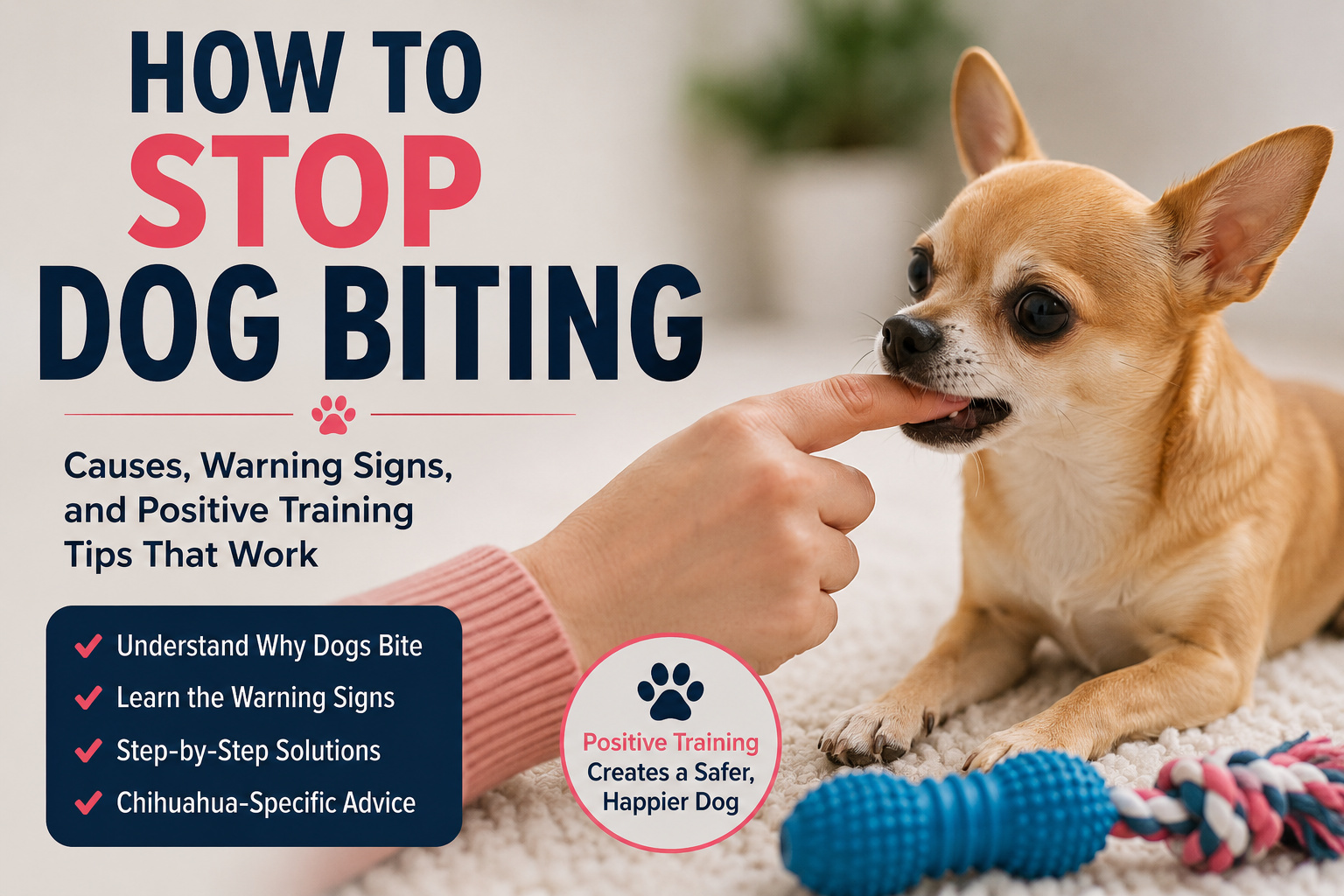
Dog biting can be scary and upsetting, especially when it involves a Chihuahua or other small dog that people expect to be “cute” instead of reactive. But biting is communication.
Dogs usually bite because they are afraid, uncomfortable, overstimulated, in pain, or they simply never learned better ways to respond.
The good news is that many biting problems can improve with patience, training, management, and understanding your dog’s triggers.
Why Dogs Bite
One of the biggest mistakes people make is assuming all biting is the same. The reason behind the behavior matters because the solution depends on the cause.
Common reasons dogs bite include:
- Fear or anxiety
- Protectiveness over people, toys, or food
- Pain or illness
- Lack of socialization
- Rough play
- Overstimulation
- Teasing or rough handling
- Territorial behavior
- Puppy teething
- Redirected frustration
A fearful dog needs a very different approach than a teething puppy.
Why Chihuahuas Bite More Than Some Other Dogs
Chihuahuas often get labeled as “aggressive,” but many are actually fearful or overwhelmed.
Because they are so small, the world can feel scary to them. People often:
- Pick them up constantly
- Ignore warning signs
- Allow behaviors they wouldn’t tolerate in large dogs
- Handle them roughly
- Fail to socialize them properly
Some Chihuahuas also become overly protective of their favorite person.
This does not mean your Chihuahua is “bad.” It simply means they need training, confidence-building, and clear boundaries.
You may also want to read our article on Chihuahua aggression for more help understanding reactive behaviors.
Learn the Warning Signs Before a Bite
Dogs almost always give warnings before biting, but many people miss them.
Watch for:
- Lip licking
- Yawning when not tired
- Whale eye (showing the whites of the eyes)
- Stiff body posture
- Freezing suddenly
- Tail tucked
- Ears pinned back
- Growling
- Snarling
- Backing away
- Hiding
Never punish a growl. A growl is valuable communication. If you punish the warning signs, some dogs learn to bite without warning.
How to Stop Dog Biting: Step-by-Step
Step 1: Figure Out the Trigger
Ask yourself:
- When does the biting happen?
- Who is involved?
- Is food, a toy, or a person nearby?
- Does your dog seem scared or overstimulated?
- Does the dog bite when touched or picked up?
Understanding the trigger is the foundation of solving the problem.
Step 2: Stop Putting Your Dog in Situations That Trigger Biting
Management is important while training is happening.
Examples:
- Give your dog a quiet space during parties
- Don’t allow rough play with children
- Avoid forcing interactions with strangers
- Use baby gates if needed
- Don’t pick your Chihuahua up constantly
Preventing repeated biting rehearsals helps break the cycle.
Step 3: Reward Calm Behavior
Instead of focusing only on stopping bad behavior, reward the behavior you want.
Praise and reward your dog for:
- Staying calm around people
- Relaxing instead of reacting
- Looking at triggers calmly
- Gentle interactions
- Choosing toys instead of biting hands
Tiny treats work great for Chihuahuas because they can eat them quickly during training sessions.
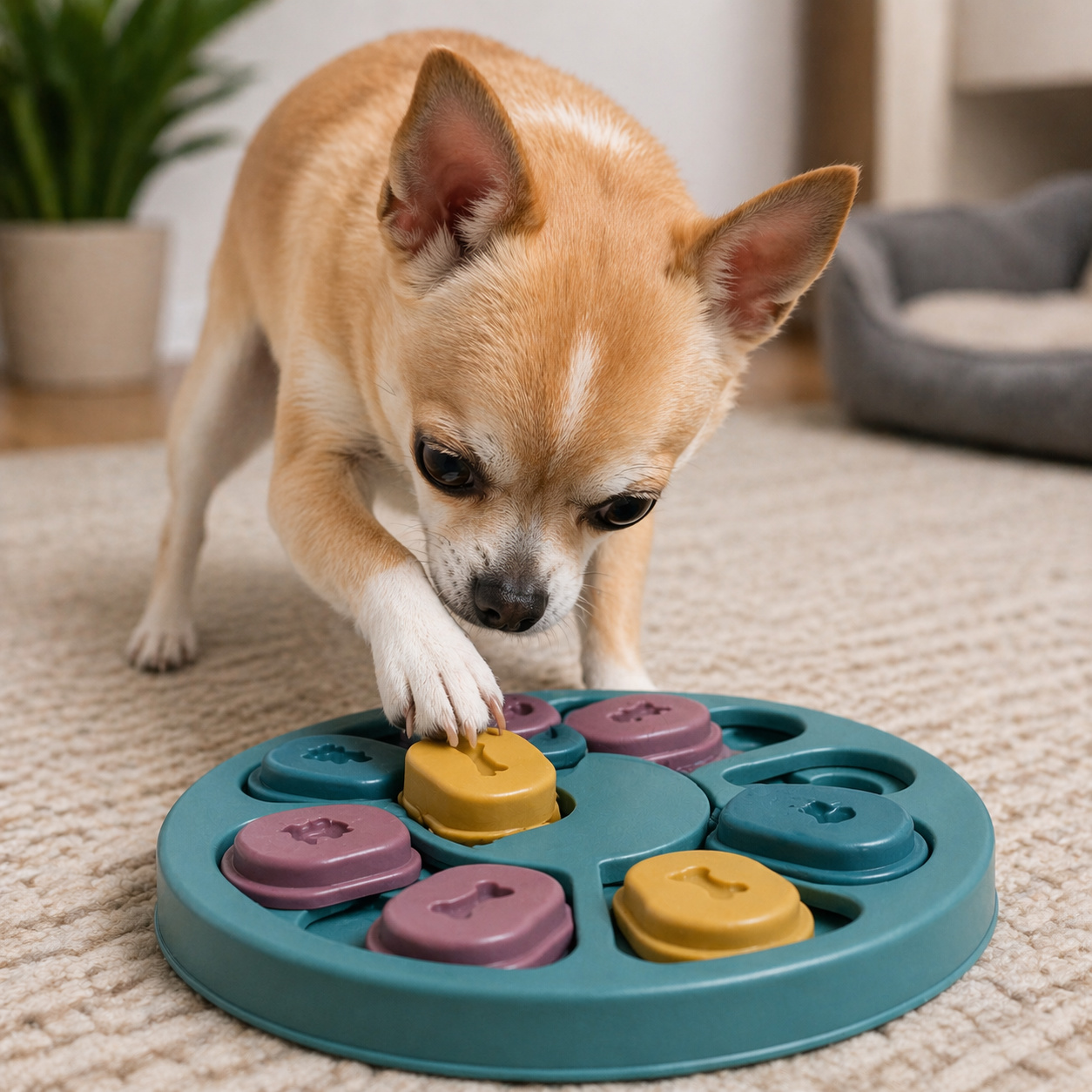
Step 4: Redirect Biting to Appropriate Items
If your dog starts mouthing or nipping:
- Redirect to a chew toy
- Offer a stuffed Kong
- Use a snuffle mat
- Try a puzzle toy
- Encourage chewing on safe dog chews
This is especially important for puppies and high-energy dogs.
Step 5: Keep Training Sessions Short
Short, positive sessions work best.
Aim for:
- 5–10 minute sessions
- Multiple times per day
- Calm environments
- Consistency
Long sessions can overwhelm small dogs, especially nervous Chihuahuas.
Step 6: Practice Calm Behavior Training
The goal is to teach your dog what TO do instead of biting.
Keep training sessions short, calm, and positive. Practice a few minutes at a time several times a day.
Some helpful exercises include:
Teach “Sit”
Ask your dog to sit before:
- getting attention
- being picked up
- receiving treats
- going outside
- getting meals
This helps teach impulse control.
Teach “Leave It”
“Leave it” teaches your dog to back away from something instead of grabbing or biting it.
Start with treats first, then slowly practice with toys and other distractions.
Reward Calm Behavior
Many people accidentally only pay attention to dogs when they misbehave.
Instead, reward your dog when they are:
- lying calmly
- relaxing near people
- greeting politely
- playing gently
- chewing appropriate toys
Dogs repeat behaviors that get rewarded.
Practice Gentle Handling
For dogs that bite during handling:
- touch briefly
- give a treat
- stop before the dog becomes upset
Slowly build positive associations with:
- touching paws
- being picked up
- brushing
- nail trims
- collar handling
Teach an Alternate Behavior
If your dog usually bites during excitement, teach them another behavior instead.
For example:
- grab a toy
- go to a mat
- sit for attention
- make eye contact
This gives your dog a safer way to respond.
End Before Your Dog Gets Overstimulated
Short successful sessions work better than long frustrating ones.
Always try to end on a positive note.
Step 7: Teach Bite Inhibition
Puppies need to learn how hard is “too hard.”
If your puppy bites too hard:
- Say “ouch” calmly
- Stop play immediately
- Withdraw attention briefly
- Resume play once calm
This teaches puppies that biting makes fun stop.
Step 8: Avoid Punishment-Based Training
Punishment often makes biting worse because it increases fear and anxiety.
Avoid:
- Hitting
- Alpha rolls
- Yelling
- Smacking the nose
- Holding the mouth shut
- Shock collars
These methods can damage trust and increase aggression.
Positive reinforcement is safer and more effective long-term.
Puppy Biting vs Aggressive Biting
Puppy biting is usually:
- Playful
- Excited
- Teething-related
- Less intense
Aggressive biting often includes:
- Stiff body language
- Growling
- Snapping
- Guarding behavior
- Fear reactions
Knowing the difference matters.
What to Do if Your Dog Bites When Picked Up
This is extremely common in Chihuahuas.
Possible reasons include:
- Pain
- Fear
- Past bad experiences
- Being startled
- Feeling trapped
Instead of grabbing your dog suddenly:
- Approach calmly
- Let them see your hands
- Reward handling with treats
- Support the entire body
- Avoid squeezing tightly
If the behavior suddenly starts, schedule a vet visit to rule out pain or injury.
You may also enjoy our article on how to train a shy Chihuahua.
When Dogs Bite Out of Fear
Fear biting is one of the most common forms of aggression.
Fearful dogs need:
- Space
- Patience
- Confidence-building
- Predictability
- Positive experiences
Never force a fearful dog to “face their fears.”
That often backfires.
Instead, slowly expose them to triggers from a safe distance while rewarding calm behavior.
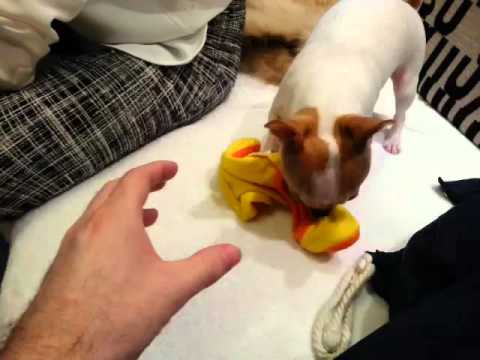
Resource Guarding and Possessive Biting
Some dogs bite to protect:
- Food
- Toys
- Beds
- Treats
- Favorite humans
This is called resource guarding.
Never try to forcibly take items away from a guarding dog.
Instead:
- Trade for something better
- Teach “drop it”
- Reward voluntary releases
- Avoid confrontation
Resource guarding can become serious, so professional help is sometimes needed.
Mental Enrichment Helps Reduce Biting
Many dogs bite more when bored or overstimulated.
Mental exercise can help tremendously.
Try:
- Puzzle toys
- Snuffle mats
- Training games
- Short walks
- Nose work
- Lick mats
- Food-dispensing toys
A mentally satisfied dog is often calmer and less reactive.
Mistakes That Can Make Dog Biting Worse
These common mistakes can increase biting behavior:
- Punishing growling
- Forcing interactions
- Inconsistent rules
- Rough play
- Teasing
- Allowing over-arousal
- Ignoring stress signals
- Using fear-based training methods
Training should build trust, not fear.
When to See a Veterinarian
Always consider medical causes, especially if:
- The biting started suddenly
- Your dog seems painful
- Your dog avoids touch
- Your senior dog becomes irritable
- The aggression is getting worse
Pain, arthritis, dental disease, neurological issues, and other medical conditions can contribute to biting.
When to Contact a Professional Trainer
Seek help if:
- Your dog breaks skin
- The bites are escalating
- Children are involved
- Your dog guards people or objects
- You feel unsafe
- Your dog shows intense fear or aggression
Look for a certified force-free or positive reinforcement trainer or veterinary behaviorist.
What Worked for Me With an Aggressive Puppy
I want to share my own experience because I know how scary and stressful dog biting can feel, especially when you realize your tiny puppy will eventually become a very large dog.
When we got Buddy, our American Bulldog/German Shepherd mix puppy, he already showed some aggressive behaviors at only 6 weeks old. He would growl, snap, and try to bite us when he became overstimulated or frustrated.
At first, it seemed almost funny because he was such a tiny little furball trying to act tough. But we knew that behavior would become dangerous once he grew into an 80-pound adult dog.
I asked a dog trainer I knew for advice, and one of the first things she recommended was staying calm and not turning the biting into a game or emotional reaction.
When Buddy tried to bite:
- We would firmly say “No”
- End the interaction immediately
- Put distance between us and him
- Ignore him briefly until he calmed down
This worked much better than yelling or physically punishing him.
We also learned that Buddy became much more bitey when he was overtired, overstimulated, or needed more exercise and mental enrichment. Short training sessions, structured routines, chew toys, and consistent boundaries made a huge difference.
One important thing I’ve learned over the years is that dog training advice has changed a lot. Some older training methods focused heavily on dominance and “being the alpha,” but many modern trainers now recommend positive reinforcement and trust-building instead.
For most dogs, especially fearful or anxious Chihuahuas, calm consistency and positive training methods are usually the safest and most effective approach.
I’m happy to say that Buddy eventually grew into a friendly, well-behaved adult dog. I truly believe early training, consistency, and addressing the behavior right away helped prevent bigger problems later on.
Final Thoughts
Dog biting can feel overwhelming, but many dogs improve greatly with patience, consistency, and understanding.
Instead of asking, “How do I stop my dog from biting?” try asking:
“What is my dog trying to communicate?”
That shift in mindset often changes everything.
With proper training, management, mental enrichment, and compassion, many dogs can learn safer and calmer ways to respond to the world around them.
FAQ
Why does my Chihuahua bite me but not other people?
Many Chihuahuas become overly attached or protective of one person. Fear, anxiety, resource guarding, or rough handling can also contribute.
Should I punish my dog for biting?
No. Punishment often increases fear and anxiety and can make biting worse. Positive reinforcement training is safer and more effective.
Do puppies grow out of biting?
Puppies naturally mouth and nip, but they still need training and bite inhibition practice. Without guidance, the behavior can continue.
Why does my dog bite when picked up?
Pain, fear, discomfort, or feeling trapped are common reasons. Chihuahuas are especially sensitive to rough handling.
Can a biting dog be trained?
Many biting problems improve significantly with consistent training, management, and professional help when needed.
When should I worry about dog biting?
You should seek professional help if bites are escalating, breaking skin, involving children, or connected to severe fear or guarding behavior.

Cathy Bendzunas
Pet Blogger
My Tony is 6 month old ! he tries to bite me all the time !
Is he just teething Renate or is he really trying to bite?
HE WAS A YEAR IN SEPTEMBER ! HE IS GOOD MOST THE TIME ! i HAD HIM SINCE HE WAS 6 WEEKS , BUT THEN HE STARTS BITEN ALL OVER SUTTEN !
Has he any training classes? A good training class might help.
My little chi’s don’t try to bite but I do have a problem with them wanting to nibble on my fingers when they are excited. I notice this especially when I get home. Any suggestions?
Those are what is called puppy nips Kelli and some dogs do it out of affection and excitement. If it hurts when they do it and you want it to stop, say “No” in a firm voice and walk away from them until they calm down.
[…] Allow you Chihuahua to Bite Under Any Circumstance. Allowing a Chihuahua to bite your hands during playtime encourages future aggressive behavior by making your Chihuahua believe that it is okay to use teeth on other people or animals. How a Chihuahua plays can reflect how they will act aggressively in public toward other dogs. If you are having issues with your Chi biting, read this: How to Stop Dog Biting […]
My chi only tries to bite one person, he really hates this person. He won’t get near this person except to try and bite him. When standing away from him he’s constantly growling at him. Any advice will be greatly appreciated.
My advice would be to get this person to start feeding him. It may take awhile though and he will need to take it slow and easy with him. If you want, I can post this question on our facebook page for more ideas for you.
I find my dog reacts to my reactions so check your feelings
Good point Susan.
My little chi girl is 18 mths old and has suddenly started to scream and nip people who go to touch her. She dosnt do this with me or my husband but she does it with my children who are 8 ,13 and 14. Especially my 14 year old who she hates with a passion. She won’t look at him and turns her face away if he is near us. He said If I am out she’s fine and sits on his knee. What can I do. Thanks laura. X
Many chis do not like kids simply because they make them nervous. Kids being kids are sometimes a little rough and clumsy around them and that scares them. They also usually prefer one person and will throw a fit if someone else wants to touch them. Since she doesn’t do this when you aren’t there, it’s that old “love the one you’re with” thing where she will accept them if that’s all that’s available to her.
You could try “immersion therapy” with your son by having him feed her, take her for a walk, etc. so she sees him as a “provider” and learns to accept him.
If you want me to post your problem on the facebok page, maybe others might have some more ideas of what to do for you.
I have always had dogs of several breeds all my life from tiny chihuahas to german shepards, right now we have 2 chihuahuas. I have had Max since he was 6 months old and he is now 6 years old and we just recently xrescued a female chihuahua she is also 6 months old, named her MaciJo. Im in no way shape or form trying to sound harsh when I say this, But in my opinion, if your dog is biting only one person, or being off standish around that one person, that person has done something to them to make them act out like that… In our household, if our babies(dogs) dont like you, neither do we. Animals are so very smart, they know when someone is bad and when to let their owners know…
That’s entirely possible Melanie.
I have a 3 month old chihuahua and am having issues with biting. Have tried the no, leave it, putting him down and walking away. It works for awhile but then it starts all over again. And his teeth are very sharp. I give him something else to chew on but my self, my husband or anyone is a chew toy to him. Any help would be so great. Thanks. Anna
Anna, is he biting because of teething? I assume so since he is 3 months old. If so, when he goes to bite I would say No, put him in his crate or playpen (playpens are wonderful for young puppies) and put a teething toy in there. Then walk away and stay away for at least 10 minutes.
He’s still a baby so he isn’t going to catch on overnight. It may take months but eventually he will grow out of the teething stage and wanting to chew on everything.
Hi I have a chi Pom mix I’ve had her since she was 5 weeks old and she will be 9 in January when she was a pup and tried to bite me or anyone in my household I would say ouch or ow she would lick me instead and to this day she has never bit anyone and barely bites down on her toys. We just got a new puppy which is an American Bulldog and we are training her the same way and it seems to be working on her too. I never yell it just say it in a quiet or normal voice.
I’m glad that worked for you Kelly. Mine have all needed a stronger voice to get the message.
my chi is almost 3 and he gets aggresive when we go to leave he bites us barks and growles he also is aggresive when we take him with us in the car when one of us gets out of the car he bites we only take him if one of us goes somewhere he dont act that way
Yeah I think your little guy thinks he’s the alpha dog and he’s trying to force you to do what he wants.
My 1 year old chi was rescued from a very abusive situation. Some kids were using her as a football, throwing her back and forth, even drop kicking her. As a result she doesn’t like to be held in my arms, she will growl the whole time and when I put her down, she tries to bite me. Then she spins in a circle several times and bites her own foot. She also doesn’t like to be touched, especially the head, where she had several stitches. She always gives a warning growl, so I speak in a calming voice, telling her no until she stops growling. But if one of my other dogs bumps her while they are playing, it sends her into her growling spinning cycle. Otherwise she is a very sweet dog. She is friendly with people but I have to warm them not to pet her because she will try to bite. I love her and would like to help her be more calm and to not bite, but I am not sure if I am going about it the right way. Any suggestions would be appreciated. Thank you.
It sounds like you are doing the right thing Mary. It’s just going to take time and some of those behaviors may never change because of all the abuse she endured.
She’s a pretty girl.
Would you like for me to ask about this on the facebook page to maybe get some more ideas for you?
Our biting started off as play cute when she was little but now she very possessive if every one of her toys so when i reach for one to engage her in play she goes. Into her attack mode. Now i have to give her a firm no and slowly get it away then play with her with it. I have to warn friends what she may do and keep my eyes on her cuz you cant predict how she is with others. My mom used to tease her like she was ging to take her toy get her all growly til mom got bit so mom let up on the teasing. Otherwise she is the most l9ving sweet chi ive ever had my constant shadow.
It sounds like you are doing the right things Carol.
Hi. My chi is 4 years old. Her name is chi chi. She bites and growls all the time, even me and everyone else in the house. She also will bit anyone who comes over. She will come over and cuddle with you, act like she wants your attention and then she bites. I can’t cut her nails, put a collar or leash on her, or tick and flea medicine without her biting. I have had her since she was 12 weeks old. She nipped a bit as a puppy but nothing like she is now. I love her to death but I don’t know what to do with her. Help please.
Chi chi is being a bully and trying to show everyone she is the Alpha by biting to get her way.
This is going to be a hard behavior to change but it can be done. You will probably need a dog behaviorist to help. There should be a few in your area but if not, here’s a good one that will work with you online: https://landmarkbehaviour.com/services
I own several chihuahuas never ever had an issue with biting
You’re lucky Debbie. Many people have issues with biting.
@Debbie Johnson, from which kennel did you get them if I can ask? 🙂
We’ve adopted an 11 year old chihuahua after her elderly owner passed away. She has settled in well with our dachshund and golden retriever. However, she is very protective of me. When I am petting our golden retriever she will try to get between us and has actually bit her to get her away from me. She does not do this with the dachshund. How do I correct this? When she first came into our home she was terrified of the golden and would charge her anytime she came close. Now she primarily gnores the golden unless I am petting her.
She has established herself as the alpha and she is telling your Golden that you are her property. When she starts that, I would immediately tell her no and put her down and ignore her for 5 minutes or so. Or if she attacks the other dog, tell her no, pick her up and put her somewhere else for 10 minutes, like a playpen or another room will she will not have access to you.
I must be very lucky but my 11 week old chi will lie down next to me when I’m eating and never try to go after my food. The first couple of times I did this all I had to say was No and he.backed right off
Yes you are lucky Laurie!
My 6 month old chi x jack russell has started biting people when they go to stroke her, it’s mainly people she doesn’t know and also if I’m holding her, I tend to carry her when we are not in open spaces as she not keen on her lead and if anyone asks to stroke her she will growl and snap at them quite Viciously.
I have 2 children 8 & 10 which she adores and will quite happily sit with any of us in the house without any Territorial tendency’s.
Any advice?
She is resource guarding you which means she sees you as her source for protections, sustenance, shelter and love. She’s guarding you against anyone who may take you away from her (in her mind of course).
This is hard to break, particularly if she is doing this when you are out and about.
If at home, tell her no in a firm voice and immediately remove her from the situation for a timeout. Put her in a closed room, crate, playpen) and ignore her for 10 minutes or so. You may need to do this over and over before she realizes this is not acceptable behavior.
My 2 Chis are rescues. Pixie (14) snapped at the toddler next door – she is under surveillance when the toddler is outside and let Pixie approach on her own terms like a short sniff and back off. Gucci on the other hand is my social butterfly BUT will growl and bite whenever I dress him up. It’s very cold here in Ottawa Canada in the winter. A few times I had to put him in the bathroom for a 45 sec timeout. I make it a game with rewards sometime when I dress him up.
Yes, too bad they don’t understand that getting dressed will mean more warmth and comfort.
We have a four year old adopted when he was three. Cheeto tries to destroy any and every one that walks in the door. He lets my husband pet him if he is on the floor (the dog not the husband). He did bite me very hard once while I was trying to pick up the food he spilled. No one can be on HIS couch except me.
I love him to death but I need help!
You may need to get a pet beaviorist to work with you on helping Cheeto.
Hi can you help me. My chi candy is a year old next month March. Hasn’t had any socialising due to a broken leg had to have a pin and wire . She was in a crate for 8weeks. Then got Desexed and two hernias removed. So more time in a crate . She is so placid never bitten anybody . Untill a lady came to pick something up at my home. I invited her in my chi was in the laundry. I opened the door and she went off at the lady. Bit her on the leg. Not bad but I was in shock as she has never done that . Why would she all of a sudden attack . The lady did say she has rag doll cats and maybe candy could smell the cats on her . I’m sending her to an all day doggy day care To get her socialised. As she is so scared of other. Dogs Maybe they will help her to relax around other dogs. Have you any advice pls to help me Debbie Also. She is starting to bark at family and friends she knows coming in to the house. Going there feet I can’t understand why. When she has always been so placid I got her at 8 weeks old She is very protective of me but is starting to be abit aggressive when people come. Just barks and barks at them too
This behavior is somewhat common with chis and usually shows up once they are adults. That could be why you didn’t see it before. Socializing may help. And the more people that come to your house will help too. If you can have some treats near the door and when anyone comes in the house, have them give her a treat. You want her to learn that people in the house are a good thing. If she takes the treat and is calm and quiet, praise her for it. If she continues to act aggressive, pick her up and put her in a closed room for a time out.
You may need to get the help of a dog trainer if nothing seems to help her.
I need so much help here. MY chi, Angel (yes, very deceiving) has turned into such a bully. We can not have any one over. She either barks at them the entire time they are there, or she bites them. My husband says she needs a shock collar, but I am not for that. Any suggestions?
Shock collars are a very bad idea for a chi. I have heard they have some out now that just have vibrations and are not painful but I don’t know anything about it.
Angel needs some professional training. If you can’t get a trainer right now due to COVID, try online training. There are a few that I know about. Train Pet Dog has a course specifically for chihuahuas. There’s also http://smalldogacademy.com/
PLEASE HELP! Determined no matter what to fix but need help.
12 Year old Chi male. Cute and friendly but.
1. Minimal scratching.
2. No holding.
3. Bites growls barks. Some of each.
4. After 3 years won’t take harness/leash.
Potty trained, kennel and carrier trained. Since
birth. Will stay near when outside listening fairly
well.
5. Knows tricks and commands with fair response but
recently angry when I give down command charges hand.
Always been his trainer.
6. Working on desensitizing him to touch and fear of harness.
FURmly believe in positive reinforcement even though some store trainers said grab him with gloves and force him. Can’t afford a trainer right now. Vet says he seems healthy.
No anger towards him . Please help. THANK YOU FOR ALL SUGGESTIONS.
Wow, Craig, you have your hands full with your little guy. I don’t know what else you can do but I can put your problem up on the Facebook page if you want to see if anyone else has some suggestions for you.
@Craig (Dad), I have a chi who sounds just like yours. I made my own leash out of shoe strings that has a emergency release so that all I have to do is lasso him and then the taking off is simple. He still flips out a lot about it but this has really helped.
Email me and I can send you one if you like. It’s worth a try I’d say. I’ve had my chi a year but he’s 3 and was abused his first 2 years. He has scars around his neck and chest area so I think that’s why he hates leash and harness and I don’t think I’ll ever get him in a harness or clothing but the crazy thing is once he gets the leash on he walks perfectly on it and loves it. It’s the on and off that makes him crazy. I’ve rescued probably 50 dogs in my life of all sizes and breeds and I can say 100% that this 3 lbs chihuahua has been the most challenging ever. I think we get good karma points for taking these challenges on. 😉
My 6 yr old male Chihuahua just started biting ankles, literally breaking the skin. He does it to strangers, he has never been socialized, it is only me and my 2 dogs at home. I have another chihuahua that is 11yrs old and she is not aggressive, I have had them both since they were puppies. Do you think there is any Hope to stop this?
Yes, there is hope but it will take some work.
Yes I bit him back and now he thinks twice
I got a rescue chi, so do not know her story. She is only 3 lbs. & is terrified of anyone walking . She doesn’t like to be picked up , but will sit on my lap. Her terms. Otherwise, she runs to her pet taxi for cover. I cannot reach in to get her, as she will bite. I have another chipoo & Peanut is definitely the leader of the pack. What can I do to make her trust me more?
Time will help some of that. It takes a long time for some dogs to trust. If she’s food motivated, use a treat when going to reach for her. She needs to learn that something good happens when you pick her up.
My older Chihuahua used to bite since we bought a younger Chihuahua it has stopped. A number of times I have heard the odd yelp but it happens rarely now. Neither bite we always use dog toys to play with them.
That’s good that it stopped John.