

Signs, Symptoms, Treatment, and How to Help Your Dog
Updated May 2026

If your Chihuahua suddenly starts making a strange honking cough, especially when excited, pulling on the leash, or after drinking water, it can be scary to hear. One possible cause is tracheal collapse, a common breathing condition in small dogs.
While hearing that diagnosis can sound frightening, many Chihuahuas with tracheal collapse still live happy, comfortable lives with proper care and management.
In this article, we’ll cover the signs of tracheal collapse in Chihuahuas, what causes it, how it’s treated, and what you can do at home to help your dog breathe easier.
What Is Tracheal Collapse in Chihuahuas?
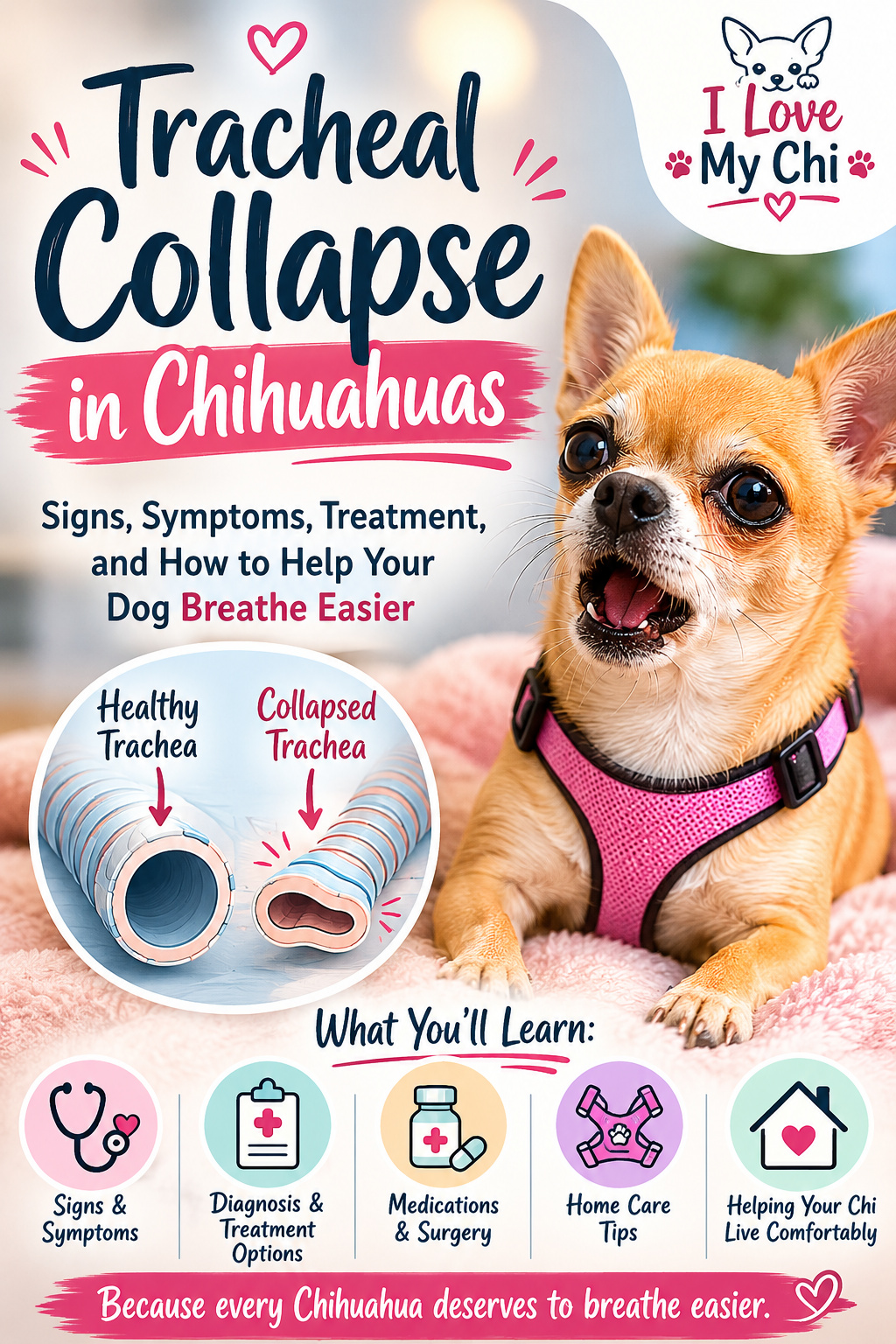
Tracheal collapse in Chihuahuas is a condition where the windpipe weakens and partially flattens, causing coughing, wheezing, and breathing difficulty. It is especially common in small dog breeds and often worsens over time without treatment.
The trachea, or windpipe, is supported by small rings of cartilage that help keep the airway open. In dogs with tracheal collapse, these rings weaken over time, causing the airway to flatten when the dog breathes.
This narrowing of the airway creates irritation and makes it harder for air to move normally.
Chihuahuas are one of the breeds most commonly affected by this condition.
What Causes Tracheal Collapse?
In many cases, tracheal collapse is believed to be hereditary, meaning some dogs are born with weaker cartilage.
However, several things can make the condition worse over time, including:
- Obesity
- Pulling against a collar
- Chronic respiratory irritation
- Smoke exposure
- Allergies
- Excitement or stress
- Heart disease
- Aging
- Respiratory infections
Even dogs with mild collapse may suddenly have worse symptoms during hot weather, excitement, or illness.
Symptoms of Tracheal Collapse in Chihuahuas
The most recognizable symptom is the classic “goose honk” cough.
Signs can include:
- Dry, honking cough
- Coughing after excitement
- Coughing after drinking water
- Wheezing
- Rapid breathing
- Gagging
- Exercise intolerance
- Difficulty breathing
- Noisy breathing
- Restlessness at night
- Fainting in severe cases
- Blue-tinged gums during breathing distress
Some dogs only cough occasionally, while others develop more severe symptoms as the condition progresses.
Mild vs Severe Tracheal Collapse
Mild Cases
Dogs with mild collapse may:
- Cough occasionally
- Only have symptoms during excitement
- Recover quickly after episodes
- Continue acting normal, otherwise
Moderate to Severe Cases
Dogs with more advanced collapse may:
- Cough daily
- Have breathing difficulty even while resting
- Tire easily
- Struggle in hot weather
- Experience frequent flare-ups
- Have episodes of respiratory distress
Because the condition is progressive, symptoms often worsen gradually over time.
Tracheal Collapse vs Reverse Sneezing
Many Chihuahua owners confuse tracheal collapse with reverse sneezing in Chihuahuas because both sound similar and can sound alarming.
Here’s the difference:
| Reverse Sneezing | Tracheal Collapse |
|---|---|
| Snorting inward sound | Honking cough |
| Usually lasts seconds | Can become chronic |
| Often harmless | Progressive condition |
| Dog acts normal afterward | Dog may continue coughing |
| Triggered by irritation | Triggered by airway collapse |
If your Chihuahua has repeated coughing episodes, especially the honking type, it’s best to have your vet check them.
Here’s an example of a Chi with reverse sneezing:
And here is a Chi with tracheal collapse:
They sound very similar, don’t they? The best way to know for sure is to get your vet to check your dog.
When to See a Vet Immediately
Some symptoms should never be ignored.
Contact your vet right away if your Chihuahua:
- Has blue or pale gums
- Collapses or faints
- Cannot catch their breath
- Has a severe cough that won’t stop
- Seems panicked while breathing
- Refuses food or water
- Has labored breathing while resting
Breathing emergencies can become serious quickly in small dogs.
How Vets Diagnose Tracheal Collapse
Your veterinarian may use several methods to diagnose the condition, including:
- Physical exam
- Listening to the airway
- Chest X-rays
- Fluoroscopy (moving X-rays)
- Ultrasound
- Sedated airway exam in severe cases
Because symptoms can resemble other conditions, your vet may also rule out:
- Kennel cough
- Heart disease
- Allergies
- Bronchitis
- Pneumonia
- Reverse sneezing
Treatment for Tracheal Collapse in Chihuahuas
Treatment depends on how severe the condition is.
Common Treatments Include:
- Cough suppressants
- Bronchodilators
- Anti-inflammatory medications
- Sedatives for severe anxiety-related flare-ups
- Weight management
- Oxygen therapy during emergencies
Some dogs also benefit from anti-anxiety medications because stress and excitement often worsen coughing episodes.
Antibiotics are only used if there is a bacterial infection present.
Surgery for Tracheal Collapse
Surgery is usually reserved for severe cases that do not respond well to medication.
There are two main surgical options:
- Tracheal rings
- Airway stents
While surgery can help some dogs significantly, it also comes with risks and expense. Not every Chihuahua is a good candidate.
Fortunately, many dogs do very well with medical management alone.

How to Help a Chihuahua With Tracheal Collapse at Home
There are several things you can do to help reduce flare-ups and keep your dog more comfortable.
Use a Harness Instead of a Collar
This is one of the most important changes you can make.
Pressure on the neck can worsen airway irritation and coughing. A soft harness helps protect the trachea during walks.
You may also want to read: Common Chihuahua Health Problems
Keep Your Chihuahua at a Healthy Weight
Extra weight puts additional pressure on the respiratory system.
Even losing a small amount of weight can sometimes improve symptoms noticeably.
Avoid Smoke and Strong Fragrances
Smoke, candles, perfumes, vaping, and aerosol sprays can irritate the airway.
Keep Excitement Levels Manageable
Many Chihuahuas start coughing when overly excited.
Try to:
- Keep greetings calm
- Avoid rough play
- Reduce stressful situations
- Create a relaxing environment
Chihuahuas with anxiety may experience more coughing episodes because stress tightens the airway.
Avoid Overheating
Hot, humid weather can make breathing more difficult.
During warm weather:
- Walk early or late in the day
- Keep exercise light
- Always provide cool water
- Avoid excessive activity outdoors
Living With Tracheal Collapse
Many Chihuahua owners are surprised to learn their dogs can still enjoy a good quality of life with this condition.
Most dogs continue to:
- Play
- Go on walks
- Enjoy family time
- Live for many years
The key is learning what triggers your dog’s coughing and managing those situations carefully.
Over time, you’ll likely notice patterns such as:
- Excitement triggers
- Heat sensitivity
- Worse symptoms during allergy season
- Increased coughing after pulling on a leash
Keeping track of these triggers can help you prevent flare-ups before they happen.
Can Tracheal Collapse Be Prevented?
Not always, especially if genetics are involved. However, you may reduce the risk or slow progression by:
- Using a harness early in life
- Maintaining a healthy weight
- Avoiding airway irritants
- Treating respiratory infections promptly
- Avoiding neck pressure
Final Thoughts
Hearing your Chihuahua struggle to cough or breathe can be upsetting, but tracheal collapse is a condition many small dogs successfully live with for years.
The most important thing is getting an accurate diagnosis, following your vet’s treatment plan, and making simple lifestyle changes that reduce strain on your dog’s airway.
With proper care, many Chihuahuas with tracheal collapse continue living happy, active lives.
Frequently Asked Questions
Can a Chihuahua live a long life with tracheal collapse?
Yes. Many Chihuahuas with mild to moderate tracheal collapse live long, happy lives with proper management.
Is tracheal collapse painful for dogs?
The condition itself is usually more uncomfortable and distressing than painful, especially during coughing episodes or breathing difficulty.
Does tracheal collapse get worse with age?
It often does. Because the cartilage weakens over time, symptoms may gradually become more noticeable as a dog ages.
Can a harness help prevent tracheal collapse?
A harness can help reduce strain on the trachea and may help prevent irritation from leash pressure on the neck.
What triggers coughing episodes?
Common triggers include excitement, exercise, pulling on a leash, heat, smoke, stress, and drinking water too quickly.
Should dogs with tracheal collapse still exercise?
Usually yes, but exercise may need to be shorter and gentler depending on the severity of the condition.
Is tracheal collapse hereditary?
Many veterinarians believe genetics play a major role, especially in toy breeds like Chihuahuas.
Can reverse sneezing turn into tracheal collapse?
No. They are different conditions, although some dogs may experience both.


Cathy Bendzunas
Pet Blogger
My older dog has it sounds exactly like the second video. He’s had it for years never had problems with it if it gets were he keeps doing it over and over I rub his neck and helps I always thought it was Luke a hair ball. Cuz he likes to lick himself lol. He’s 13 years old and has had it as long as I have knows him almost 8 years.
Glad he isn’t having any issues with it. He’s a cute boy Kesha.
My 11 yr old Chi sound just like the 2nd video. Thank you so much for posting this article with examples. I’ve been making harnesses for Chili for the last 6 yrs and he coughs if I pick him up too high on his rib cage.
He also coughs when excited.
You’re welcome Michelle. He’s handsome!
My baby,Tequila sounds like the second video also. I’m going to have a talk with my mom about smoking around her. I will also be consulting her vet about a weight loss program. This was so very helpful.
I’m so glad it was helpful to you Samantha! I love your little Tequila!
My 18 year old chi had a collapsed trachea. In addition to medication she had frequent cold laser treatments which reduced the inflammation
Interesting. I haven’t heard of cold laser treatments before.
@Diane Pallitto, can you tell me more about the cold laser treatments? My 14.5 year old chihuahua had this and just passed away from complications with pancreatitis and collapsed trachea which caused ARDS. If my 8 year old chihuahua gets this, I would like to do the cold laser treatments for her. Thank you.
My 13 year old westie cross has trachea collapse its so worring, she seems okay one minute then it starts really upsetting x
I’m so sorry Julie. I can see how that would be upsetting. What does your vet say about it?
There is nothing they do just wish they could give her a medicine xx thank you for your kind words, bless her she is fine otherwise.
@kilosmom, my Yorkshire terrier has this problem and is on steroids but this has caused more problems i think now may be cushings disease not good she is very small my white chi is bigger.What are symptoms of cushings is liver affected am trying to reduce steroids but do not think possible 12 yrs old
I’m so sorry your yorkie is having these health problems. I have heard that continued use of steroids can cause liver issues. I don’t know all that much about Cushings but I found this article that has symptoms of it here: https://www.fda.gov/consumers/consumer-updates/treating-cushings-disease-dogs
My TINKER just turned 8 on 6-8-16…3-4# is her weight…. HONKS when she drinks water..occasionally when excited…… When I calm her, stroke her throat gently, her stress reduces, struggle ceases , …. Glad to know about this issue, will continue to supervise closely….. Hv already lost one CHI to CUSHINGS… Sure don’t want to give up another…. TU??❣
Hopefully Tinker’s is just reverse sneezing which sounds the same but it is something to watch and let your vet know about. Thanks for posting Robin.
I have also lost a fur baby to Cushing’s who acted like the second video. I now have 2 Chi’s who both act like the second video; Tilly is four and Milo is two. I will definately talk to my vet as I always thought they were reversing sneezing and maybe it may be something more serious.
Let us know what the vet says Eva.
My chi has collapsed treachea. I go to a vet that uses homeopathic and traditional medicines. The natural medicine has been an amazing supplement. It is called Spongia. Don’t just go and order it online….your vet has to prescribe the correct dose. I have seen a totally different dog. Now don’t get me wrong there are days that he needs his cough tabs and bronchial dialater meds plus sometimes a sedative. But thanks to the Spongia instead of having to give those heavy drugs 2 to 3 times a day. Most times it’s just the Spongia. And now he’s on a stronger dose of the Spongia he doesn’t even take that everyday now, just 2 times a week. If your vet is not open to a holistic approach definately find a new vet.
I wish their were more vets out there that embraced traditional medicine and holistic medicine. That’s the best of both workds.
I haven’t heard of spongia before but I’m going to go research it. Thanks for letting us know about it Keri.
Our best fury friend Easydog, a 10 year old male long haired chihuahua, has got tracheal collapse. The first months he was on terrible chemicals( poison i call it) and then i switched to a homeopathic vet and since then, the last two years we manage it very well.
He looks healthy, eats very healthy, only organic raw food, filtered water, and his chinese herbs and homeopathic drops. He dos not have a cough at all but he shows some signs of being tired quickly. He likes to play but is exhausted quickly. Since he is on alternative medication his situation is not getting worse. It is very important to use no chemicals at all because that will imbalance your fury friends immunity system enormously!
What ever the ‘Chemical’vets say any vaccines given to your puppies are just obstructing what the body does naturally, fighting bacteries and virusses. You put chemicals in their body and the immunity system stops working properly. Instead of using Lasix use high strength celery. Works fantastic for my little one. Infections you can fight with Turmeric. Better used ‘Golden Paste for dog’ do a search on Google to find the recipe.
Also a problem that small puppies has to cope with is that they live very close to the ground,soil and that means they get the most concentrated toxic smell, because exhaust of cars are heavier than air and will hang very close to the ground. Alo a lot of people and councils use Roundup everywhere and we but definately our fury friends get that toxic stuff more concentrated in our bodies.
There is so much information out there, but please do not read the information about the companies who make them but read the other once.
I did some research about cartilage regeneration when using low level laser – cold laser.
on humans. This therapy does regenerates cartilage in joints etc. While the trachea is kept open by rings that are made from cartilage, why not trying to restore it with that laser therapy. I You can’t find a lot of information on the internet doesn’t mean that the information isn’t out there!
I bought a LL Laser and will start treatment on my partners knee and on our best fury friend Easydog his trachea . I will keep you informed.
Easydog is a very handsome boy Rudy.
More and more, I am agreeing with you about the chemical thing. I find for myself Tumeric works well with infections and cinnamon mixed with Manuka honey keeps me from getting colds, the flu and such.
Do keep us informed with how he does with the laser thing.
thank you Cathy. If you already doing it, but going certified organic does make a huge difference to your body. Glyphosates, used in Roundup weed killer, is found in almost all the foods sold at your supermarket. Dry foods for the animals are NOT healthy. I did not invent that but do some research yourself to find out. To much carbs and proteins in it. Did you know that 30 years ago vets the rates of pets having cancer was 1 per 100. Apparently now it is 1 per 1.6!!! Thats scary isn’t it!
You have to keep in mind:’If the gut is healthy, you will be healthy’ and that’s the same for your fury friends.
Rudy, what do you feed Easydog?
Hi Cathy,
What’s on Easy’s menu? I feed him chicken, pork, fish. I mix some organ meat such as liver, kidneys, heart, but a tiny amount. The veggies are raw but very fine. I mix them in a mixer and add organic coconut oil. I give him 65% meat, 15% organ meat and 20% veggies.
I mix also vitamins and minerals. I got this from a Holistic vet in the area where i life. By the way i live in Australia 🙂
I feed him a little bit meat in the morning, at noon he gets his raw chicken wing(i hold it in my hand so he can chew it) and at Dinner mentioned here above.
Do not overfeed. Remember they have a very tiny stomach 🙂
A few years ago we still fed him what we ate ourselves and cooked his meat and vegetables. But the vet said to feed him what the dogs normally eat in the wild…….RAW RAW RAW! They do not use pots and pans in the wild 🙂 In the beginning, we were not sure about the change of diet, but after a few weeks he was so much healthier and his teeth stayed much longer clean too. That’s what the bones do too! Bones Provides calcium and scrapes the plaque from the teeth.
I hope this helps Cathy
What i would like to mention Cathy is that pet owners have to do more research about the medication and vaccines the vets give to their pets. The time that you have to dig into an encyclopedia is over. All the information is out there. So use it!!!
This is an interesting article about vaccines. Whatever vets say
http://www.dogsnaturallymagazine.com/five-vaccine-ingredients-that-can-harm-your-dog/
@rudy, can I ask if you saw any improvement from using the LL Laser on Easydog’s trachea? Our chi also has tracheal collapse so I’m interested to know how you got on.
My 11 year old child has it and has an enlarged heart. He can’t take some of the meds because of his heart. He is now on 2 heart meds, a diuretic, and an allergy med. He has some days were he coughs alot but most days it’s just a little here and there. He doesn’t let it stop him doing what he wants. He has always been a good lap dog and the best snuggler. He will always be our baby.
Poor little guy. Glad he’s handling it pretty well Jessica!
Hi,
Dogs with collapsed or collapsing trachea tend to get infections in the upper resperitory airways. Because the lungs can’t get rid of germs in the airways due to lower air flow. When taking a shower take your fury friend with you so he can breathe some water vapor. Helps cleaning the airways and keep them moist too! I have spread all over the house some difusers with Eucalyptus ess oil. Instead of giving your puppy or fury friend chemical diuretic give him some celery powder in each meal you serve him. I use high strenght celery capsules from healthy essentials. I give my boy half of a capsule mixed in his meal and that works for him. Chemical diuretics can give these side effects;
Dehydration
Increased water intake
Increased sensitivity to light
Lethargy
Restlessness
Increased heart rate
Tilting of the head in cats
Reduced ability to hear in cats
Vomiting
Diarrhea
Seizures
Loss of appetite
So celery is not a bad option at all 🙂
Interesting info Rudy. I haven’t heard of celery powder before. I love the idea of diffusers and Eucalyptus oil. I have been thinking of getting some for myself to help with my asthma and I have 6 sugar gliders who LOVE Eucalyptus.
My 6 year old chi was diagnosed with a collapsing tracea earlier this year my her vet. Even though she at that time was only 7.4 pounds, the vet put her on a diet . She wanted her down to 5 pounds. A visit to the vet a couple of weeks ago she is down to 5.6 pounds. Almost at her goal. She is also on medication twice a day. She is doing much better-coughing spells are very rare now. Not like before when it was several times a day. Now she might only have one a week-if that.
That’s awesome Brenda!
Sometimes when my female overweight chi is accidently startled from sleeping, she will do what the second video shown. She is approximately 8 years old and also has epilepsy that is controlled by phenobarbital.
I have heard of that happening when they get started before Christine. I’m glad your chi’s epilepsy is under control.
My rescue chi had her vocal chords cut (or voice box removed, not sue=re which, hard to say since she is my first chi) before I ever adopted her. I notice the reverse sneezing more so when she is heavier. She also has the “floating knee cap” which limits her physical activity, hence the obesity at times. She spends 99% of her time sleeping or moving back and forth between the 3 dogbeds I’ve put down for her. She freezes when she is picked up so I rarely do that. When she does run “down the hall to go outside” it’s like a rabbit..bit walking I see the loose knee pop out as she moves. I will not put her through surgery for fear she won’t make it through the anesthesia. Any suggestions from anyone? She is at least 15 yrs old, I’ve had her for more than 8 yrs, but worry more as she gets older.
Yeah at 15 years old, surgery might not be a good idea. Has your vet given you any options other than surgery?
We do have an article on this although, I’m not sure it will give you much more info about it than you already know.
Since she is overweight and her reverse sneezing gets worse when she’s heavier, you should measure her food and keep it under a cup for the whole day. You can go as low as a 1/4 of cup of food if needed but I wouldn’t start her out quite that low.
[…] Tracheal Collapse in Chihuahuas | I Love My Chi says: July 5, 2016 at 4:53 pm […]
SHould we be feeding these dogs softer food?
Softer food may be easier for the dogs to eat so it’s worth a try to see if it helps Kim.
my sisters chi just had a lump removed from her stomach. since the removal of this lump, the dog coming home from the vets hospital , she has been coughing. Is this the same thing as a tracheal collapse???? the vet has prescribed several forms of meds and now prescribing presnazone (spelling) He dog is 9 years old and has never coughed before this operation. she has been told it is because they have a small tracheal that is was scratched.. is this for real or what???
Yes that can happen during surgery when they put a breathing tube down their throat. They do have small tracheas that are easily damaged.
My baby Peanut is a Chihuahua 12 years old, rescued him from an illegal breeder when he was about 5. He has been diagnosed with a collapsed trachea and its disturbing to see him gasping for air, he is so helpless and there is nothing I can do – so frustrating. Was just diagnosed last week and next steps is to figured out what meds to give him. They gave me cough syrup but that did not help, now we are trying two cc’s Benadryl – this seems to work a little better but not enough. He is scheduled for a visit with an internal medicine doctor to see what other options if any we have. They mentioned something called a trachea wash? At his age just putting him under for the procedure is a risk, I hate to see him suffering wish there was more I can do!
Poor little guy.
I had to look up trachea wash to see what it involved.
Let us know what they decide to do Jose.
Ask your vet about SAC or isopreul elixir. Trachea wash will suck up some fluid that they test for bronchitis and other respiratory issues
Hi i have a chi that we rescued from the sheltrr and she had surgery to remove all her teeth, now she sounds like she has tracheal collapse could this be from them using a breathing tube during surgery?
Yes, that very well could have caused it Russeall.
Good article and appreciate all the replies w variations on treatment Especially the holistic. Our cheweenie just diagnosed after breathing issues lasting longer than a reverse-sneeze scenario. Vet x-rays confirmed collapsed trachea. Prescribed low dose prednisone. We will wean from the RX ; try holistic remedies.
Let us know how the holistic stuff works out for your chiweenie Tony.
Hello
I have an 8 and half week old black tiny chihuahua puppy. I had him a day then he started coughing when I got home from work one day. He gags but does not throw up and coughs a lot. I took him to 2 different vets and I’m starting to get frustrated because I feel like nothing I have given him has helped he is still doing it and it seems to really bother him when he is sleeping. His name is Prince and I was given clavox as the antibiotic but he seems to be getting worse. He does not sound like the either of the videos u had posted. He is wheezing too but eating and drinking normal and still plays with me. But when he starts gagging he runs away. I’m so lost please help!!!
Heather
I’m assuming the vet thought he had kennel cough or an upper respiratory infection but if the antibiotics aren’t working, it’s probably not that.
He may have tracheal collapse or reverse sneezing but because he’s a young puppy, it sounds different. Did either vet do any x-rays or anything? That would rule out tracheal collapse because it can usually be seen in an x-ray.
I’m not sure what to tell you. You may want to go through all the comments and maybe try some of the things other pet parents have tried and had success with.
My six pound Chihuahua was diagnosed with trachea collapse in January 2018. I began treating him with an energy healing that my wife and I administer. His recovery was 10% after one month. This improved to 60% after two months and 90% after three months.
I am talking about his overall body cartilage consistency.
The actual collapsed trachea went from a 40% collapse to less than 20%, which is where we are now.
I have before and after videos, too.
Given this success, we are launching a business treating trachea collapse in small dogs and cats. We are offering a full money back guarantee if we can’t improve your pets condition by 25% in the initial six weeks of treatment.
We now accepting our initial clients!
Alan
641.233.1036
Interesting Alan. What ind of energy healing are you doing? Reiki?
No, not Reiki. It’s not a well known program. In fact, I know of only a hand full of people who do this.
Read down my revised post about the published scientific studies on the technique.
I’m working on a website now. Here is the link, but it is still in the development phase.
Go to this site and have a look around …
https://sitebuilder-664407227.zohositescontent.com/zcms/editor
Alan
The link is for your editor, not the actual site so it wouldn’t let me in.
I have some videos on Facebook. Would you like to talk?
Alan
641.233.1036
Why don’t you leave the link to your videos or the facebook page they are on so we can check them out. I’m sure others will be interested too.
My dogs don’t have any medical issues right now so I don’t really need this but I am curious about it.
Ok, I’ll get that posted on Wednesday. Thanks.
This is a similar comment to above, but is edited a little better …
Thanks,
Alan
My six pound Chihuahua was diagnosed with trachea collapse in January 2018. I began treating him with an energy healing that my wife and I administer. His recovery was 10% after one month. This improved to 60% after two months and 90% after three months.
I am talking about his overall body cartilage consistency.
The actual collapsed trachea went from a 40% collapse to less than 20%, which is where we are now.
I have before and after videos, too.
Given this success, we are launching a business treating trachea collapse in small dogs and cats. We are offering a full money back guarantee if we can’t improve your pets condition by 25% in the initial six weeks of treatment.
We have been studying the effect of these energy healings and to date we have invested over $100,000 in published scientific studies documenting the validity of our program. We can provide these studies upon request.
We are now accepting our initial clients!
Alan
641.233.1036
I don’t know how old all these threads are but for Alan,… would you mind posting more information on what can be helpful to those of us that probably can’t afford your “healing energies” program but we’re willing to try various things to help our poor little chi’s…. I have 2 chi’s (13 and 15 YO) and they both seem to have the collapsing trachea. I will be checking into the Spongia and will also look for a holistic Vet (which I haven’t found in my area yet). Thanks for all the great info Cathy! Love all the great info here!
You’re welcome Carmen!
@Alan Balmer, I am interested to know more about the energy healing.
Bessie
My Luis (male chi) developed the trachea problem after he was choked by a groomer at PetCo. He looks just like the dog in the video. Fortunately he doesn’t seem to have trouble all the time, but when he does it is very hard to listen to. Needless to say I no longer go to PetCo.
I’m so sorry that happened to your Luis! It makes me glad (as a former professional groomer) I can groom my own dogs. It’s hard trusting them with others. I know I worked with a few groomers that were less than gentle with the dogs and it broke my heart for those pups.
I have a baby that is a product of two “designer dogs”. She is my world and now despise any and all breeders of designer dogs. Anyway…. She has several health issues. My worry is how does treachea prolapse effect her life span. Currently she is thriving with the help of cough suppressants.
She is so pretty Shelly!
I’m not going to lie, complications of tracheal collapse can shorten her life but it doesn’t necessarily mean it will. Just make sure, she continues to get good medical treatment, make sure she doesn’t get chubby (it’s worse in overweight dogs), don’t let anyone smoke around her, and always use a harness when she’s on a leash.
My Chihuahua Phoebe who will be 13 on Halloween was diagnosed with the early signs of a collapsing trachea. She was examined by internist and a cardiologist. No heart problems. At the beginning she was on hydrocodone 3 times a day but then as needed. She is doing better. Her coughing is not severe like it was and sometimes she can go 24 to 48 hrs without medicine. I have been trying to get her to lose weigh Although it is a slow process she has lost a pound. I try not to get her to excited.
Sounds like you are doing everything right for her Sandy, Hope she continues to stay well.
Our Chihuahua puppy is almost 5 months old. He snores at times when sleeping. He also ‘honks’ occasionally. Usually 2-3 times but recently woke us up in middle of night, doing it about a dozen times. Sounded like he was in such distress! I just happened to be taking him to vet in the morning so I explained to tech what was going on. While sitting in my car (thank you Covid) the vet called me & asked if he was in a daycare or do we go to dog parks. I said no. Then she asked if it sounds like a honking and I said ‘yes, exactly!’ She informed me about tracheal collapse but did say the only way to really diagnose it would be to X-ray during a cough. Sent us home with cough pills, 1/4 every 6-8 hours. If it stops, discontinue pills until it starts again. That’s the only day he got pills, 3 days ago. Made the noise once when we went for a walk yesterday. On a leash, with a harness. He was very excited, and I keep the leash very short as to keep him off other’s lawns. My sisters friends dog has it and she seems to think our little guy is doomed! He only weighs 4.1 pounds. Is very active, loves to run. My vet said it’s sounds worse than it is & will not shorten his life. I’m so confused!
Your vet is right. Dogs can have a long life with it. A few do have a lot of health issues and may die early but most don’t.
@Cathy, is there anything we can do at home to keep him healthier? We are smoke free, I read we should not use aerosols, try to take him for daily walks (in Michigan, lucky not to have accumulated snow yet!) Seger, yes like Bob, likes to sleep late in mornings but is usually active most of day. That is as long as I don’t sit because then he finds his way you my lap. Lol We waited 7 years after we lost our 13 year old rott/shepherd mix because we were so heartbroken after her death. Now this. Is there any way I can ‘follow’ you? Join something? In order to ask questions when things pop up. Thank you.
My chihuahua just sounds like the first,thank you so much,I was so worried
My CHi just had luxating patella surgery and we found out she had a collapsed trachea after she developed aspirated pneumonia.
Oh wow, I’m so sorry T.
My 7 yr old toy chi has been diagnosed. On meds. Some days are better than others. I worry so much i will find him dead. Hes my baby and we love him so much. I hate hearing him retch. Up at 4 am googling this. Im just wondering if theres anything i can do. Surgery sounds expensive.
Surgery should be a last resort but you might want to start saving up for it now.
There are natural supplements out there that some say help build cartilage. The ones I know about are glucosamine, MSM and chondroitin but I don’t know if these really do help or not. Some people give their dog honey mixed with warm water to help soothe their trachea.
Other than that, I don’t know what else you can do for your fur baby.
My Chihuahua has
this condition when excited. I just settle him down and issue is resolved.
My Chihuahua has tracheal collapse. 4 days ago at 130am he just started coughing aggressively, we took him to the emergency vet and they said it was kennel cough. They drugged him up pretty good so the next 24 hours he was fine. But when the 24 hours were over, he started coughing even worse. Took him in again where they then did am xray. Told us he has it. And we needed to get him medication ASAP, and pretty much made it seem like he was about to die. So thw next day which was a monday we took him in and she explained everything(something the emergency didnt do). They said there was 3 different things they wanted to check for so they sent new xrays of that day(he was such a good boy that day, almost no coughing, not a hard belly and ate and drank) to a radiologist to see which problem was the worst. They vet said she thinks the enlarged heart was from him not getting the air he needs. And he had fluid in his lungs. So instead of treating tracheal collapse, they wanted to treat whatever was causing the most harm. . they did a much better job at their job than the emergency vet…. So now we are on day 4 and he sleeps on 2.5 hour intervals, coughs for about 2 minutes. And then sleeps again.. I can see he wants to be himself. You can just see the fear in his eyes.
Poor little guy. I’m so sorry ya’ll are going through this Suzy!
My dog Brownie was a rescue, the vet said she was approx 6-7 years old. She was used as a breeder, as she was very small, and had great features. The first six months, my vet pulleld some of her teeth, and spayed her, she had licked her hair so much in that case, it was completely wrapped around all of her teeth. That was approx 3 years ago.
I also have to mention, during fireworks or loud noises, she appears not to breath and her mouth locks open??
Took her in 1 year ago, and had rest of her teeth removed. They were very bad, but said it has not affected her organs.
Approx 1 weeks ago she started with the coughing as dog #2 in video, it continued to worsen. Then she would get better and start to eat again.
Last Sunday during the day she had a couple of episodes of coughing with a frothy foam coming from her mouth. I read that a little honey with warm water was good for that. I did the honey thing for a couple of days. On the 3rd day in the evening (Sunday) she started coughing and could not stop, it almost looked like a seizure. I was holding her, and it continued, aslo with her mouthing locking open. She died in my arms approx 20 minutes later. We are broken hearted, and want to know what could have happend. It appears that the treachal collapse was a problem, but shouldnt the vet of saw that during her teeth removal. We are just looking for some type of closure, as we are blaming ourselves, wishing we would have taken her to be checked out when the coughing began.
Hearts Broken in Cali…
Oh my gosh! I’m so sorry Lynn! That’s awful. I’m glad though that she had a good final years with yall feeling loved and cared for.
Yeah your vet should have at least suspected it. But it may have been congestive heart failure too. In the final stages they cough a lot. But then again, I would have thought they would have checked her heart before putting her through surgery the year before.
Our chi was born not breathing and has always had some sort of breathing problem. She does the reverse sneeze thing and now that she’s gotten older, she’s 12, she’s now doing the tracheal collapse cough, we’ve seen a post on here before for a product called Throat Gold. We have recently in the past three months gotten her on one dose at night and it seems to be helping. Our chi would wake up in the morning coughing, or in the middle of the night, since the Throat Gold, she sleeps great and wakes up happy.
Thanks for letting us know about the Throat Gold. Hope it continues.
Our 14 year old chihuahua has symptoms of the dogs in both videos. It has progressively gotten worse.It honks day and night
and sneezes sometimes difficulty with breathing.
Does it sound as though the trachael surgery is an only option?
Only your vet can answer that Brian. I know there are several medications they can try first but if it’s too severe, sometimes surgery is the only option.
I loved my beloved chihuahua in August 2022, two weeks after the vet diagnosed her with a collapsed trachea. He gave her a prescription cough suppressant. Knowing what I learned after she passed, I wish he had prescribed steroids to treat the collapsed trachea instead of treating the cough. 😔😔😔
I’m so sorry Laurie! Did the vet know it was tracheal collapse and still only prescribed cough meds?
I AM SEARCHING FOR CHIHUAHUA/jack socks or shoes by BELLA WHO IS JUST STARTING TO GO FOR BABY CARRIAGE RIDES AND THEN MY HUSBAND TRIES TO TAKE HER OUT ON THE LEASE AND SHE DOES NOT LIKE HER FEET ON GROUND ONLY GRASS. ADOPTED AT 8 WEEKS SHE IS ONLY POTTY PAD TRAINED SINCE SHE WAS THE RUNT AND ONLY 1 POUND…ALL THE LOCAL PET STORES ARE OUT OF THEM DUE TO SUPPLY ISSUES… WE WOULD LOVE TO KNOW WHERE WE CAN GET SOCKS OR SHOES SO WE CAN TAKE HERE TO DOG FRIENDLY PLACES
MANY REGARDS…LOVE LOVE LOVE YOUR COLUMN MAKES ME SO HAPPY LIKE MY BELLA
Check on Etsy. I have seen them on there in the past.
My Chihuahua has gone through so much. The vet just isn’t sure what she has. She has been on two antibiotics twice a day for months, f amotad ine twice a day for month and a cough syrup twice a day as long. Also she had me treating her with benedryl twice a day. She said she has crackles in her lungs and they are not going away. She also has a mild tracheal collapse and now one of her airways looks suspicious. She did blood work and X-ray last week and now says her liver numbers are high. So she put her on a diet of nothing but chicken and rice. The cough syrup is making her very constipated now. I was making her food with chicken breast, rice, chopped spinach, pumpkin and carrots. I have spent thousands of dollars in the last 6 months. Do you have any ideas? She is a 20 year old 9 pound deer head chihuahua. I am desperate and very sad for her
Oh wow, poor little fur baby! I’m sorry, I don’t have any ideas for you. I do know milk thistle is good for the liver. When my liver numbers were high, my doc told me to take it and it did bring my liver back to normal. I did do a google search to see if milk thistle is okay for dogs and it is but I’d ask your vet about it to be sure.
Sorry,she is 10 years old.
There is an updated video from Dr. Becker on YouTube. Here is the link.
https://www.youtube.com/watch?v=J3N7G2Ti53k
Thanks Tom, I updated the post.
I found the articles about reverse sneezing and tracheal collapse very interesting as my little Teddy, has had the same problems. Antibiotics cured it, thank goodness. He is my life.
One thing though, I have read and been told by my vet, that you should never put a collar on a Chihuahua because of the difference in their tracheas and the rubbing on them. Only ever use a harness.
That’s very true and it’s for all small dogs, not just Chihuahuas.
My older baby, Peanuts 11 years old has tracheal collapse and heart value problems. The meds work IF I can get them down him. The liquid is easy as I put it in needle dispenser and it goes down easy. However, giving him 1/4 pill and 1/2 pill of two other meds was a challenge. I bought all pill treats to hide them and he wouldn’t eat any of them. Couldn’t fool him ever! Too smart for me. Then I discovered the peperoni treat is the best place to but into little sections and dig out the middle just enough to drop a pill into it, push the meat back into it and sit on the floor and give one at a time. and he is so excited to get the other four pieces from me, he doesn’t even know he is getting his meds
I have noticed that I am sleeping better now, and darling Peanuts is doing so much better because he is feeling better. Nothing is going to cure his heart condition but it’s quality of life and he is having a great one. he loves to chase butterflies and birds, and bark at the neighbors dog who he has a crush on, and he is sleeping better.
I hope this helps anyone struggling to get those meds down when our babies run and hide.
That’s great that you found something that works. With one of my dogs, I had to crush the pill up, add a small amount of water to it, and put it in a syringe to squirt down his throat.